
Oregon DMV Permit Practice Test 9
Test 9 of 10. Pick an answer for each question to see if it is right and why; your score appears at the end. You need 28 correct answers to pass, the same ratio as the real Oregon test.
- Questions35
- Correct to pass28
- Passing score80%
- Minimum age15 years
-
1. You pass into a work zone with a reduced speed limit but you see no workers. What speed applies?
Show answer
Answer D: The posted work zone limit, whether or not workers are present
A posted work zone speed limit is a regulatory limit in force at all times, and narrow lanes and uneven surfaces remain dangerous when nobody is working.
-
2. A driver reaching a stop sign is required to do what?
Show answer
Answer D: Come to a complete stop and then proceed only when it is safe
A stop sign requires a full stop before the stop line, crosswalk or intersection, after which the driver may go on once the way is clear.
-
3. The blue signs mounted before a freeway interchange that carry the logos of individual businesses are
Show answer
Answer C: specific service signs, which show the brands available at that exit
Specific service signs, often called logo signs, list eligible businesses for categories such as gas, food, lodging, camping, attractions and 24-hour pharmacies at the upcoming interchange.
-
4. A child in the back seat unfastens a seat belt while you are on the freeway. What should you do?
Show answer
Answer A: Pull off safely and refasten the belt
Turning or reaching back takes your eyes and hands off a high speed task, so leave the freeway or use the shoulder only if there is no exit, then fix the belt.
-
5. In Oregon, careless driving is normally a Class B traffic violation. What happens to its classification if the careless driving contributes to a crash?
Show answer
Answer D: It becomes a Class A traffic violation, the most serious traffic violation tier
ORS 811.135 upgrades careless driving from a Class B to a Class A traffic violation when the offense contributes to an accident.
-
6. Your navigation device tells you to turn where a road sign says the turn is closed. What should you do?
Show answer
Answer B: Follow the signs and what you can see
A device works from stored data that can be out of date, while signs and the road in front of you show the situation now, so the road wins every time.
-
7. Besides antique vehicles, which of the following is also exempt from Oregon's financial responsibility requirements under ORS 806.020?
Show answer
Answer A: A motor assisted scooter
ORS 806.020 lists a motor assisted scooter among the vehicle types exempt from Oregon's financial responsibility requirements.
-
8. A child seat was in the car during a moderate crash. What should be done with it?
Show answer
Answer A: Replace it, because a seat that has been through a crash may be weakened
Crash forces can damage a seat in ways you cannot see, so a seat involved in anything but the mildest crash is replaced.
-
9. An Oregon applicant under 18 wants to count only 50 supervised driving hours instead of 100 by taking an ODOT-approved traffic safety education course. What must DMV receive before this reduction is allowed?
Show answer
Answer B: Proof of completion of the course
The Oregon Driver Manual states that DMV must receive proof of completion of the ODOT-approved traffic safety education course before the supervised driving hour requirement is reduced from 100 to 50.
-
10. The light turns yellow when your front wheels are already past the stop line inside the intersection. What should you do?
Show answer
Answer B: Keep going and clear the intersection without speeding up
Once you are legally in the intersection the safest and correct action is to continue through and clear it, without accelerating.
-
11. How many correct answers are needed to pass the Oregon Class C knowledge test?
Show answer
Answer B: 28
Oregon requires 28 correct answers out of 35 on the Class C knowledge test, which works out to 80 percent.
-
12. You notice a bulge on the sidewall of one of your tires. What should you do?
Show answer
Answer D: Have the tire replaced before driving far, because it could blow out
A sidewall bulge means the internal cords have broken and only the rubber is holding the air. The tire can fail suddenly at any speed.
-
13. Why should you not rest your foot on the brake pedal as you drive?
Show answer
Answer D: The brake lights stay on and the drivers behind cannot read you
Resting on the pedal keeps the brake lights lit and wears the brakes, so following drivers stop believing your brake lights.
-
14. In Oregon, what maximum speed applies on a road or highway with no other designation?
Show answer
Answer C: 55 mph
Oregon sets 55 mph as the maximum for roads and highways that carry no other designated speed, while designated interstate segments can be posted higher.
-
15. What is the correct first step when parallel parking behind an empty space?
Show answer
Answer D: Signal, pull up alongside the vehicle in front of the space, then back slowly into it
Parallel parking is done in reverse from a position alongside the vehicle ahead of the space, because backing in lets the rear wheels guide the vehicle to the curb.
-
16. An overhead sign shows that the right lane is EXIT ONLY. What does that mean if you intend to stay on the highway?
Show answer
Answer B: You have to move out of that lane before the exit
An exit only lane leaves the highway completely, so a driver continuing on the highway has to change lanes before it does.
-
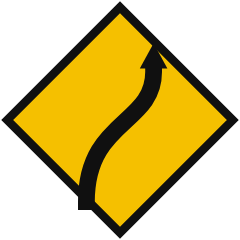
17. What does this sign tell a driver about the road ahead?
Show answer
Answer A: The roadway changes direction ahead, so speed should be reduced before reaching it
It gives advance notice of a change in alignment so the driver can slow down before entering, since braking inside a bend uses up grip that is needed for steering.
-
18. When required to stop for a railroad crossing in Oregon and there is no stop line, how far from the nearest rail must a driver stop?
Show answer
Answer C: At least 15 feet
The Oregon Driver Manual states that when required to stop and there is no stop line, a driver must stop at least 15 feet from the nearest rail.
-
19. During which period are studded tires generally allowed in Oregon?
Show answer
Answer D: November 1 through March 31
Oregon generally permits studded tires only from November 1 through March 31, because of the pavement damage they cause.
-
20. Why does a long downhill grade lengthen the distance you need to stop?
Show answer
Answer C: Because gravity keeps pulling the vehicle forward as you brake
On a downgrade gravity works with the vehicle and against the brakes, so the same speed needs noticeably more distance than it would on level ground.
-
21. What Oregon maximum speed applies in a business district or a school speed zone?
Show answer
Answer B: 20 mph
Oregon sets 20 mph in business districts and school speed zones, while residential districts, public parks and permitted ocean shores are 25 mph.
-
22. Under Oregon law, if a driver is traveling at or below the posted speed limit, does that alone guarantee compliance with the basic speed rule?
Show answer
Answer B: No, the posted limit does not authorize a speed higher than conditions allow under the basic speed rule
ORS 811.108 clarifies that speed limits under ORS 811.111 do not authorize speeds higher than the basic speed rule permits, and the basic speed rule likewise cannot authorize exceeding the posted limit.
-
23. The curb ahead is signed as a bus stop. May you wait there with your vehicle?
Show answer
Answer C: No, the space must stay clear for buses
A bus stop must stay open so that a bus can reach the curb and let passengers on and off safely, so no other vehicle may occupy it.
-
24. An arrow panel at a work zone displays a flashing arrow pointing to the left. What does it require?
Show answer
Answer C: Move out of the closed lane into the lane on the left
A flashing or sequential arrow on an arrow panel directs traffic out of a closed lane and into the lane the arrow points to.
-
25. You reach a four-way stop after another driver has already stopped there. What should you do?
Show answer
Answer D: Let the driver who stopped first proceed before you go
At a four-way stop the vehicles proceed in the order they arrived, so a driver who stopped before you goes first.
-
26. Why is hard braking the wrong response to a tire blowout at speed?
Show answer
Answer C: Because it can pull the vehicle further out of line and start it spinning
With one tire gone the braking forces are uneven, so heavy braking increases the pull to one side and can spin the vehicle.
-
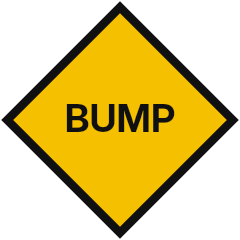
27. How should a driver respond to this sign?
Show answer
Answer C: Slow down before reaching the rough spot and cross it at a steady, low speed
Losing speed before a sharp rise in the pavement keeps the vehicle settled, while braking or accelerating on top of it unsettles the suspension and costs grip.
-
28. Why does this warning matter more on a motorcycle than in a car?
Show answer
Answer B: Because a sudden jolt can unsettle a two-wheeled machine and the rider can lose control
A jolt can push a motorcycle off line or lift a wheel, so a rider slows early, comes slightly off the seat and keeps a relaxed but firm hold on the handlebars.
-
29. You have stopped after a crash. Why should the engines of the vehicles involved be switched off?
Show answer
Answer A: To reduce the risk of a fire starting around any fuel that has spilled
Crashes often break fuel lines, and a running engine is a source of ignition, so switching off lowers the risk of fire.
-
30. Your light turns green while a pedestrian who started on the walk signal is still crossing in front of you. What must you do?
Show answer
Answer D: Let them finish crossing the road before you move off on your green light
A pedestrian who entered the crosswalk lawfully keeps the right of way until they reach the other side, whatever the signal now shows.
-
31. May you stop in the striped triangle that separates an exit ramp from the freeway lanes?
Show answer
Answer A: No, it is not a lane and stopping there is dangerous
The striped gore area is not a travel lane or a shoulder, and a vehicle stopped there sits directly in the path of drivers correcting a late exit.
-
32. The engine dies at speed and the dashboard lights go out on a dark road. What should you do?
Show answer
Answer C: Hold the wheel firmly, steer over to the shoulder and use the hazard lights
Never switch the ignition to lock, because the steering can lock; steer to the shoulder and warn traffic with the hazard lights.
-
33. You are involved in a collision, even a minor one. What is your first legal duty?
Show answer
Answer A: Stop at or near the scene without blocking traffic more than necessary
Every driver involved in a crash must stop at the scene, and leaving before meeting that duty is a serious offense. Move the vehicles only as far as needed to clear the traffic lanes.
-
34. You realize your tires are running on ice. Which set of inputs is safest?
Show answer
Answer C: Gentle steering, no sudden braking, and no sudden acceleration
Whatever grip is left is used up at once by any sudden input, so every movement of wheel, brake and accelerator must be slow and small.
-
35. In Oregon, if a driver has valid insurance but simply does not have proof of it in the vehicle when stopped, what is true about the resulting citation?
Show answer
Answer D: It is dismissed if proof of coverage is delivered before the court date
ORS 806.012 makes failing to carry proof of financial responsibility a Class B traffic violation, but the court must dismiss the charge if the person delivers proof of compliance to the court clerk before the scheduled court date.