
Oregon DMV Permit Practice Test 4
Test 4 of 10. Pick an answer for each question to see if it is right and why; your score appears at the end. You need 28 correct answers to pass, the same ratio as the real Oregon test.

- Questions35
- Correct to pass28
- Passing score80%
- Minimum age15 years
-
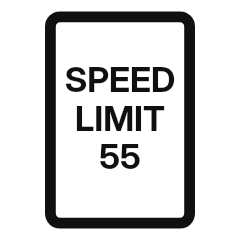
1. On a clear day with light traffic, a driver stays far below the maximum this sign sets. What can that cause?
Show answer
Answer B: Obstruction of the normal flow of traffic, which is prohibited in itself
Driving so slowly that other traffic is impeded is an offense in its own right when nothing about safety, weather or the road calls for it.
-
2. Which of these vehicles is exempt from Oregon's financial responsibility (insurance) requirements under ORS 806.020?
Show answer
Answer D: An antique vehicle issued permanent registration
ORS 806.020 exempts an antique vehicle issued permanent registration under ORS 805.010 from Oregon's financial responsibility requirements.
-
3. How long must an applicant under 18 hold an Oregon instruction permit before getting a provisional driver license?
Show answer
Answer B: 6 months
An Oregon applicant under 18 must have held an instruction permit for at least 6 months, and an out of state permit counts toward that requirement.
-
4. Which person's presence in the vehicle excuses a 16- or 17-year-old provisional license holder from the first six-month passenger restriction, besides an approved course instructor?
Show answer
Answer A: A parent or stepparent who holds valid driving privileges
ORS 807.122 excuses the passenger restriction for a 16- or 17-year-old when an instructor is present for a certified traffic safety education course, or when a parent or stepparent with valid driving privileges is in the vehicle.
-
5. Outside a city, on a non-arterial highway in a residence district with no posted speed, what speed is prima facie evidence of a basic speed rule violation in Oregon?
Show answer
Answer A: 25 miles per hour
ORS 811.105 sets 25 miles per hour as the prima facie evidence speed for a non-arterial highway in a residence district located outside a city.
-
6. You have parked a manual transmission car facing downhill. Which gear should you leave it in?
Show answer
Answer D: Reverse, along with the parking brake set firmly
Facing downhill the car would roll forward, so reverse gear opposes that movement while the parking brake and turned wheels back it up.
-
7. How much supervised driving experience does Oregon require of an applicant under 18?
Show answer
Answer D: 100 hours, or 50 hours with an approved traffic safety education course
Oregon requires 100 hours of supervised driving experience, reduced to 50 hours if the applicant completes an approved traffic safety education course.
-
8. A driver hunting for an on-ramp meets this sign at the mouth of the pavement ahead. What is the correct action?

Show answer
Answer C: Keep out of that roadway and look for the proper approach elsewhere
The restriction is absolute and does not depend on how much traffic is present, so the driver has to reach the highway by an approach built for entering vehicles.
-
9. During the second six months with an Oregon provisional license, what is the passenger limit?
Show answer
Answer C: No more than three passengers under 20 who are not immediate family
In the second six months the Oregon provisional license holder may carry no more than three passengers under 20 who are not immediate family members.
-
10. What is true about an airbag once it has inflated in a crash?
Show answer
Answer B: It must be replaced by a technician before the car is driven any further
An airbag is a single use device, and the module and often the belts must be replaced before the vehicle protects anyone again.
-
11. A school bus ahead of you has its red lights flashing and its stop arm extended. What are you required to do?
Show answer
Answer A: Stop and stay stopped until the lights stop flashing and the bus starts moving
Flashing red lights and an extended stop arm mean children are getting on or off, so traffic must stop and wait until the bus withdraws the signals and moves again.
-
12. Once you are moving, which way of using a navigation device costs you the least attention?
Show answer
Answer B: Listening to the spoken directions
Voice guidance lets you keep your eyes on the road, while anything that needs the screen takes glances that add up over a trip.
-
13. A flagger turns the paddle to the orange face reading SLOW. What does that tell approaching drivers?
Show answer
Answer D: Reduce speed and continue through the work area with care
The SLOW face keeps traffic moving at a reduced speed while workers or equipment are close to the travel lanes.
-
14. What is threshold braking?
Show answer
Answer C: Braking hard but staying just short of locking the wheels
A rolling tire grips better than a sliding one, so the shortest stop comes from pressure held just below the point where the wheels lock.
-
15. In Oregon, a registered proctor supervising an online knowledge test for an applicant under 18 may supervise how many tests within a 24-hour period?
Show answer
Answer B: Only two
The Oregon Driver Manual limits a registered proctor to supervising only two online knowledge tests within any 24-hour period.
-
16. Is it safe to check your phone while stopped at a red light?
Show answer
Answer B: No, you may miss the signal change and hazards around you
Attention does not return instantly when the light changes, and emergency vehicles, pedestrians or a rear-end threat can appear while you are stopped. Stay focused on the road.
-
17. What most often starts a rear wheel skid?
Show answer
Answer A: Too much speed, braking or acceleration for the grip available
A skid begins when what you ask of the tires exceeds what the surface can give, which is usually a matter of speed and of how abruptly you use the controls.
-
18. A new DUII charge becomes a Class C felony in Oregon if the person has how many prior DUII convictions within how many years of the current offense?
Show answer
Answer B: Two or more prior convictions within 10 years
ORS 813.011 elevates DUII to a Class C felony once the defendant has at least two prior DUII convictions, in any combination of jurisdictions, within the 10 years before the current offense.
-
19. You make eye contact with a driver waiting to pull out of a side street. What should you assume?
Show answer
Answer D: The driver may still not have seen you, so stay ready to slow or stop
Drivers can look directly at you and still not register your vehicle, especially a small one. Eye contact helps, but never rely on it.
-
20. You are in the middle lane of a one-way street with three lanes when a police car approaches from behind with lights and siren. What should you do?
Show answer
Answer C: Pull to the nearest curb and stop clear of the lanes
On a one-way street you clear to whichever curb is closest, so the emergency vehicle gets a clear path down the open lanes.
-
21. You approach an intersection where the signal is flashing yellow. What should you do?
Show answer
Answer D: Slow down and cross the intersection with caution
A flashing yellow signal warns you to slow down and cross with care; it does not require a stop, but it does not give you priority either.
-
22. How can you tell that a child safety seat is installed tightly enough?
Show answer
Answer C: It moves less than an inch side to side or front to back at the belt path
A correctly installed seat is nearly immovable where the belt or lower anchors pass through it. Excess movement lets the child's body travel farther in a crash.
-
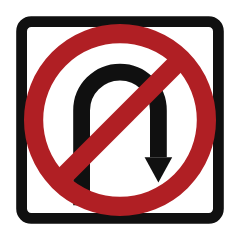
23. A driver who wants to reverse direction arrives at this sign. What is allowed?
Show answer
Answer C: Going on and reversing direction only where the maneuver is permitted
The restriction removes that maneuver at that spot entirely, so the driver has to continue and turn the vehicle around at a place where it is not prohibited.
-
24. Heavy rain has left standing water on the road where this sign is posted. What does the law expect of the driver?
Show answer
Answer C: Driving below the posted figure, at a speed that suits the conditions
Drivers must adapt to conditions, so in rain, fog, snow or dense traffic the safe speed falls below the posted maximum and keeping to that maximum can itself be an offense.
-
25. You must leave your vehicle beside a narrow rural road at night. What should you do?
Show answer
Answer B: Get it right off the pavement and switch on the hazard lights
A vehicle left on an unlit rural road is very hard to see, so move it completely clear of the traveled surface and mark it with the hazard lights.
-
26. A person with a guide dog is standing at the corner facing the street you are about to cross. What should you do?
Show answer
Answer D: Stop well back and wait quietly for them to decide
Blind pedestrians rely on engine sound to judge traffic, so stop back from the crossing and avoid the horn, which only confuses them.
-
27. How can you check that you are keeping a safe following distance?
Show answer
Answer A: Count at least three seconds between the vehicle ahead passing a fixed object and your reaching it
Pick a fixed roadside object, start counting when the vehicle ahead passes it and make sure at least three seconds elapse before you reach it, adding more time in poor conditions.
-
28. On traffic control devices, the color green shows direction to a destination and also shows
Show answer
Answer C: that a movement is permitted
Green carries two assignments: guidance toward destinations, and the idea that the movement shown is allowed, as on a green arrow.
-
29. Why is heavy braking a poor idea while two wheels are still on a soft shoulder?
Show answer
Answer B: The two sides have different grip, so the vehicle can pull sharply
With one pair of wheels on pavement and the other on loose material, hard braking slows one side more than the other and swings the vehicle around.
-
30. Under Oregon law, when an ambulance or emergency vehicle using its signals approaches, what must a driver do besides yielding the right of way?
Show answer
Answer B: Drive to a position as near as possible and parallel to the right-hand edge or curb, clear of an intersection
ORS 811.145 requires a driver approached by an ambulance or emergency vehicle, in addition to yielding, to move as near as possible and parallel to the right-hand edge or curb, clear of any intersection.
-
31. You are driving on a rural road with no sidewalk. Where should you expect to meet pedestrians?
Show answer
Answer A: Walking toward you on your side of the road
Where there is no sidewalk, pedestrians are taught to walk facing traffic, so they appear on your side of the road coming toward you.
-
32. When does Oregon require headlights to be turned on?
Show answer
Answer A: From sunset to sunrise, and any time you cannot see vehicles 1,000 feet ahead
Oregon requires headlights from sunset to sunrise and at any other time when conditions prevent you from seeing vehicles 1,000 feet ahead.
-
33. In a work zone a flagger is directing traffic in a way that conflicts with the posted signs. Whom do you follow?
Show answer
Answer B: The flagger's directions
A flagger controls traffic through a work area that changes from day to day, and those instructions take precedence over the fixed signs and markings in that zone.
-
34. How does higher speed affect the outcome of a crash?
Show answer
Answer A: It leaves less time to react and greatly increases the force of impact
Speed shortens the time available to avoid a hazard and raises the energy released in an impact, so both the likelihood and the severity of a crash increase.
-
35. You have stopped on the shoulder of a busy freeway with a flat tire that you cannot change safely. Where should you and your passengers wait?
Show answer
Answer A: Well away from the traffic side, behind a barrier or up the bank if there is one
People struck on the shoulder are a common cause of roadside deaths, so wait away from the traffic side and behind any barrier.