
Oregon DMV Permit Practice Test 8
Test 8 of 10. Pick an answer for each question to see if it is right and why; your score appears at the end. You need 28 correct answers to pass, the same ratio as the real Oregon test.
- Questions35
- Correct to pass28
- Passing score80%
- Minimum age15 years
-
1. You have a small extinguisher and a fire has started under the hood. What is the safe way to use it?
Show answer
Answer B: Release the latch and spray through the gap without raising the hood at all
Opening the hood feeds the fire a rush of air, so spraying through the gap at the base of the flames is both safer and more effective.
-
2. On an unlit road, about how far ahead do high beams normally let you see?
Show answer
Answer D: About 350 to 500 feet ahead of the vehicle
High beams light roughly 350 to 500 feet of road and low beams far less, which is why night speeds have to be chosen around the beam, not the limit.
-
3. Why should heavy objects in the passenger compartment be secured?
Show answer
Answer A: Because loose objects fly forward in a crash and can injure the people
Anything loose keeps traveling at the speed of the vehicle when the vehicle stops, so it strikes the occupants with great force.
-
4. What does Oregon's Implied Consent law mean for a driver stopped by police?
Show answer
Answer D: By driving, the person has agreed to take a breath, blood or urine test when asked by an officer
Under Oregon's Implied Consent law the act of driving is itself agreement to submit to a breath, blood or urine test, and refusal can bring a fine and suspension of driving privileges.
-
5. A tractor-trailer is backing slowly across the roadway to enter a loading dock. What should you do?
Show answer
Answer C: Stop and wait until the truck has finished the maneuver
A backing truck driver has a very limited view and the trailer can swing unexpectedly. Trying to squeeze past in either direction risks being crushed.
-
6. The signal turns green as you approach an intersection. What is the safest practice?
Show answer
Answer B: Look left, then right, then left again, and make sure the intersection is clear before entering
A green light gives permission but does not guarantee the intersection is empty, and a quick scan catches a vehicle running the red or a pedestrian still crossing.
-
7. You are approaching a yield sign and no other vehicle is anywhere in sight. What does the sign require?
Show answer
Answer A: Slow down and be ready to stop, but stop only if needed
A yield sign requires you to slow and give way, and to stop only when traffic or pedestrians make stopping necessary.
-
8. Rain is heavy enough that you have your windshield wipers running. What else should you switch on?
Show answer
Answer A: Your headlights, so you can see and others can see you
Rain heavy enough to need wipers also cuts how far away you can be seen, so the headlights belong on. Many states write this into law as a wipers on, lights on rule.
-
9. What must you do before changing lanes, in addition to signaling and checking your mirrors?
Show answer
Answer D: Glance over your shoulder to check the blind spot the mirrors do not cover
Mirrors leave an area beside and behind the vehicle that they cannot show, so a quick head check is needed before the vehicle moves sideways.
-
10. A driver behind you on a two-lane road clearly wants to pass. Why should you not wave that driver past?
Show answer
Answer B: You cannot see the whole road ahead for them and they may rely on your signal
Waving another driver out invites them to trust your judgment of a road you cannot see well enough, and the decision to pass belongs to the driver making it.
-
11. What does the Oregon Driver Manual say about driving around or under a railroad crossing gate?
Show answer
Answer D: It is against the law and extremely dangerous, whether the gate is down, being raised, or being lowered
The Oregon Driver Manual states it is against the law, and extremely dangerous, to drive around or under a railroad crossing gate while it is down or while it is being raised or lowered.
-
12. How many questions are on the Oregon Class C knowledge test?
Show answer
Answer C: 35
The Oregon Class C knowledge test is made up of 35 multiple choice questions covering road signs, traffic laws and safe driving.
-
13. A pedestrian is waiting to cross ahead of you and you have slowed down. What helps most?
Show answer
Answer D: Making eye contact, so that you both know you have seen each other
Eye contact confirms that you have seen each other; waving someone across can send them into the path of another vehicle.
-
14. What are Oregon's minimum liability limits for bodily injury and property damage?
Show answer
Answer B: 25,000 dollars per person, 50,000 dollars per collision and 20,000 dollars property damage
Oregon requires 25,000 dollars per person and 50,000 dollars per collision for bodily injury, plus 20,000 dollars per collision for damage to the property of others.
-
15. A sign on a long downgrade points to a runaway vehicle ramp. What is that ramp for?
Show answer
Answer C: Trucks that have lost braking ability on the grade
A runaway ramp is an escape lane of loose material that stops a heavy vehicle whose brakes have overheated or failed, so it must always be left clear.
-
16. When no speed is posted, what speed is prima facie evidence of a basic speed rule violation on an alley or narrow residential roadway in Oregon?
Show answer
Answer C: 15 miles per hour
ORS 811.105 sets 15 miles per hour as the prima facie evidence speed for an alley or narrow residential roadway when no other speed is posted.
-
17. What should you expect while driving through a parking lot?
Show answer
Answer D: Pedestrians and vehicles moving from any direction, so drive slowly
Parking lots mix walking people, reversing vehicles and poor sight lines, so low speed and constant scanning are the only reliable protection.
-
18. Violating Oregon's safe-distance law for a stopped vehicle displaying hazard or warning lights is classified as what?
Show answer
Answer B: A Class B traffic violation
ORS 811.147 classifies failure to maintain a safe distance from a stopped vehicle displaying warning or hazard lights as a Class B traffic violation.
-
19. A white arrow painted in your lane points only to the right, and a sign above the lane shows the same movement. What must you do?
Show answer
Answer C: Turn right from that lane
Pavement arrows used with lane-use signs are regulatory, so a driver occupying that lane must make the movement shown.
-
20. Under Oregon law, how closely may a driver follow an emergency vehicle or ambulance that is responding to a fire alarm or emergency?
Show answer
Answer C: No closer than 500 feet
ORS 811.150 makes it an offense to follow an emergency vehicle or ambulance responding to a fire alarm or emergency at a distance closer than 500 feet.
-
21. Why are drivers required to turn the front wheels when parking on a grade?
Show answer
Answer A: So that a vehicle that starts to roll leaves the traffic lanes instead of entering them
The wheel position is a last line of defense if the parking brake or transmission fails, directing the vehicle into the curb or off the roadway.
-
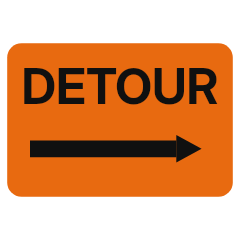
22. Once a driver has joined the route this sign begins, how is the rest of the way marked?
Show answer
Answer B: By further markers of the same kind at each turn, until the original road is rejoined
The alternate route is signed continuously, with a marker at every turn, so a driver with no local knowledge can follow it back to the original road.
-
23. You are waiting to pull out of a driveway when a bicyclist comes along the bike lane in front of you. What must you do?
Show answer
Answer D: Wait until the bicyclist has gone past
A driver leaving a driveway yields to everything already on the road, and a bike lane is part of the roadway.
-
24. You arrive at an intersection with no signs, no signals and no markings at the same time as a vehicle on the road to your right. What must you do?
Show answer
Answer B: Yield to the vehicle on your right
At an uncontrolled intersection you must yield to a vehicle already in the intersection or approaching from your right.
-
25. In Oregon, knowingly giving a police officer false information about your motor vehicle liability insurance coverage is classified as what?
Show answer
Answer B: A Class B misdemeanor
ORS 806.055 makes knowingly giving false information about liability insurance coverage to a police officer a separate Class B misdemeanor, a criminal offense rather than a traffic violation.
-
26. Why are motorcycles so often missed by other drivers?
Show answer
Answer C: Their narrow shape is easily hidden in traffic
A motorcycle presents a narrow outline that disappears behind pillars, mirrors and other vehicles, and it is harder to judge its speed and distance.
-
27. On a highway with mileage-based exit numbering, you have just passed exit 42 and are looking for exit 55. About how far is it?
Show answer
Answer B: Thirteen miles
With mileage-based numbering each exit takes the number of the nearest milepost, so subtracting one exit number from another gives the distance in miles.
-
28. Oregon law generally requires a cyclist to ride in an adjacent bicycle lane when one exists. Under ORS 814.420, which situation excuses this?
Show answer
Answer B: Safely overtaking another bicycle, vehicle, or pedestrian that cannot be passed within the lane
ORS 814.420 excuses a cyclist from the mandatory bicycle lane requirement while safely overtaking and passing another bicycle, vehicle, or pedestrian that cannot be safely passed within the lane, among a few other listed exceptions.
-
29. You are driving through a neighborhood where several children are riding bicycles. What should you do?
Show answer
Answer C: Slow down and expect sudden, unpredictable moves
Young riders lack the judgment and the mirror habits of adults and may swerve or cross without looking, so lower speed is your only reliable margin.
-
30. Your power steering fails while you are driving. What happens and what should you do?
Show answer
Answer B: Steering becomes much harder but still works, so slow down and pull off the road
Without power assistance the steering still works, but it takes much more effort, especially at low speed. Keep both hands on the wheel and get off the road.
-
31. You are traveling in the same direction as a funeral procession and want to get ahead of it. What should you not do?
Show answer
Answer B: Driving in between the vehicles of the procession
Most states prohibit driving into or through a funeral procession, and cutting into the line leaves the drivers behind with no lead vehicle to follow, so go around only where passing is permitted.
-
32. Who may supervise an Oregon instruction permit holder?
Show answer
Answer D: Any licensed driver at least 21 years old, seated beside the permit holder
Oregon requires the supervising driver to hold a valid driver license, be at least 21 years old and sit beside the permit holder.
-
33. Your car is sinking after leaving the road into deep water and two children are in the back. In what order should you act?
Show answer
Answer D: Free yourself from the belt first, then release the children, the oldest one first
You cannot help anyone while you are still belted in, and the oldest child released first needs the least help getting out.
-
34. A large truck ahead of you in a roundabout is using part of both lanes as it goes around. What is the correct response?
Show answer
Answer B: Stay back and give it room until it leaves the roundabout
Long vehicles need extra width to get around the central island, so drivers behind must hold back rather than share the space beside them.
-
35. At a stop sign with a painted stop line and a crosswalk, where must you stop?
Show answer
Answer D: At the stop line, before it and before the crosswalk
You stop at the stop line first, and only if there is no stop line do you stop before the crosswalk, and only if there is neither do you stop before entering the intersection.