
Oregon DMV Permit Practice Test 1
Test 1 of 10. Pick an answer for each question to see if it is right and why; your score appears at the end. You need 28 correct answers to pass, the same ratio as the real Oregon test.

- Questions35
- Correct to pass28
- Passing score80%
- Minimum age15 years
-
1. You are turning right off a street into a parking lot driveway that crosses a bike lane and a sidewalk. Who has the right of way?
Show answer
Answer D: Pedestrians on the sidewalk and riders in the bike lane
Turning into a driveway means crossing the paths of people who were already traveling straight, so you give way to both the bike lane and the sidewalk.
-
2. At what blood alcohol concentration does Oregon law presume that a driver 21 or older is impaired?
Show answer
Answer C: 0.08 percent
Oregon presumes impairment at a blood alcohol concentration of 0.08 percent or more, although a driver may still be arrested for DUII at a lower level.
-
3. Which steering method gives the most control when you must turn the wheel a long way at low speed?
Show answer
Answer C: Hand over hand, feeding the wheel from one hand to the other
Hand over hand keeps both hands on the wheel through a large turn, so you never lose the ability to correct quickly.
-
4. If a driver's careless driving contributes to the serious injury or death of a vulnerable road user in Oregon, what must the court order in addition to any other penalty?
Show answer
Answer A: A suspended fine of up to $12,500, a suspended one-year license suspension, and 100 to 200 hours of community service tied to traffic safety
ORS 811.135 requires a court to order a suspended fine of up to $12,500, a suspended one-year license suspension, and 100 to 200 hours of community service focused on traffic safety when careless driving contributes to a vulnerable road user's serious injury or death.
-
5. A steady green downward arrow is displayed above the lane you are in. What does it tell you?
Show answer
Answer A: You may drive in that lane
A green downward arrow means the lane beneath it is open for travel in your direction.
-
6. Why is a U-turn on a one-way street a problem?
Show answer
Answer A: You would end up facing the wrong way against all the traffic
Every lane of a one-way street runs the same way, so turning around leaves you driving head-on against all of the traffic.
-
7. According to the Oregon Driver Manual, when may a driver turn in front of a streetcar or light rail train traveling in the same direction from an adjacent lane?
Show answer
Answer A: Never, even if the streetcar or train is currently stopped
The Oregon Driver Manual instructs drivers to never turn in front of a streetcar or light rail train traveling in the same direction from an adjacent lane, even if the streetcar or train is currently stopped.
-
8. You are approaching the entry of a roundabout and a pedestrian is crossing the marked crosswalk on your approach lane. What must you do?
Show answer
Answer D: Stop before the crosswalk and let the pedestrian cross
Roundabout crosswalks sit a short distance back from the yield line, and drivers must yield there before they ever reach the circulating lanes.
-
9. Your loaded vehicle weighs more than the figure shown on a posted weight limit sign. What must you do?
Show answer
Answer D: Find another route, because crossing is not permitted
A posted weight limit is a legal maximum, not advice, so an overweight vehicle has to take a different route.
-
10. You are making a legal U-turn at an intersection. Who has the right of way?
Show answer
Answer C: Everyone else, until your turn is complete
A U-turn crosses several paths at once, so you yield to oncoming vehicles, to crossing traffic and to pedestrians before starting it.
-
11. Under Oregon's current self-serve fueling law, how does self-service gasoline availability differ between the state's 20 rural counties and its other 16 counties?
Show answer
Answer A: 20 rural counties allow self-serve at any pump anytime; the other 16 limit it to about half of a station's pumps
Under Oregon's 2023 self-serve fueling law, the 20 designated rural counties allow customers to pump their own gas at any station at any time, while the other 16 counties limit self-service to no more than half of a station's pumps, with the rest staffed.
-
12. You come up behind a bicyclist who is descending a steep hill in the middle of the traffic lane. What should you take into account?
Show answer
Answer D: The rider may be moving at close to the speed of the traffic
A bicycle can reach the speed of traffic on a descent, so there is little to gain from a pass and the rider needs the whole lane to steer around surface hazards.
-
13. What is the proper use of the horn?
Show answer
Answer C: To give a brief warning when another road user may not have seen you
The horn is a warning device meant to alert someone to your presence when a collision is possible, and using it in anger tends to escalate conflict rather than prevent crashes.
-
14. A person convicted of driving uninsured in Oregon must then file and maintain proof of financial responsibility with DMV for how long?
Show answer
Answer C: Three years
ORS 806.010 requires a person convicted of driving uninsured to file and thereafter maintain proof of financial responsibility with DMV for a period of three years.
-
15. What night driving restriction applies to an Oregon driver under 18?
Show answer
Answer B: No driving between midnight and 5:00 a.m. without a listed exception
An Oregon driver under 18 may not drive between midnight and 5:00 a.m. unless traveling to or from work or a school event, or accompanied by a licensed driver at least 25 years old.
-
16. Where are children in the greatest danger around a school bus?
Show answer
Answer B: In the roadway right around the bus, especially in front
The danger zone is the band of roadway around the bus where the driver's view is poorest, and children crossing in front of the bus are hardest to see.
-
17. Your vehicle does not have antilock brakes and you must stop quickly on a slippery road. What is the correct technique?
Show answer
Answer B: Apply the brakes firmly without locking the wheels, releasing slightly if they lock
Locked wheels slide and cannot steer. Squeezing the brakes to just short of lockup, and easing off if they lock, gives the shortest stop with control.
-
18. How does a NO OUTLET sign differ from a DEAD END sign?
Show answer
Answer B: It warns that a whole group of streets has no way out
No Outlet is posted where the road leads into a network of streets from which there is no through route, while Dead End refers to the single street itself.
-
19. What does Oregon law call it when a driver operates a vehicle with another person sitting in the driver's lap or embrace?
Show answer
Answer A: Driver operation with obstructing passenger, a Class D traffic violation
ORS 811.190 makes it the specific offense of driver operation with obstructing passenger, a Class D traffic violation, when another person is in the operator's lap or embrace while driving.
-
20. It is cold and the road looks wet, but you notice the tires of vehicles ahead are throwing up no spray. What does this suggest?
Show answer
Answer B: The surface has frozen and is probably icy
Water throws spray, but ice does not. A shiny road with no spray in freezing temperatures is a strong sign of black ice, so slow down and avoid sudden inputs.
-
21. The vehicle you want to pass is traveling close to the speed limit. What should you do?
Show answer
Answer C: Stay behind, because a pass may not take you over the limit
The speed limit applies while passing too. If you cannot complete the pass without exceeding it, do not start the pass.
-
22. Why is passing on a curve prohibited even when the traffic seems light?
Show answer
Answer C: You cannot see far enough around it to know the lane is clear
A pass is only as safe as the distance you can see, and a curve hides the very lane the maneuver uses.
-
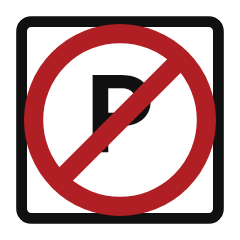
23. Why is this restriction so common beside fire hydrants, crosswalks and intersection corners?
Show answer
Answer C: To keep sight lines open and leave access for emergency crews
A vehicle left in those places hides pedestrians from approaching drivers, blocks the path of turning vehicles and can keep firefighters from reaching a hydrant.
-
24. Why is parking too close to a street corner prohibited?
Show answer
Answer D: Because it hides approaching traffic and pedestrians
A vehicle parked at a corner blocks the view that both drivers and pedestrians need before entering the intersection.
-
25. You are approaching a multilane roundabout. When should you choose your lane?
Show answer
Answer C: Before you enter, using the lane-choice sign on the approach
You select your lane on the approach the way you would at any multilane intersection, then stay in that lane all the way around, because changing lanes inside a roundabout creates side-impact conflicts.
-
26. For an alert driver, about how long is the reaction time once a hazard has been recognized?
Show answer
Answer A: About three quarters of a second
Reaction alone takes roughly three quarters of a second for an alert driver, and perception takes about as long again, so a second and a half of travel is added before the brakes bite.
-
27. Under Oregon law, exceeding a posted speed limit by 21 to 30 miles per hour is punishable as which class of traffic violation?
Show answer
Answer B: Class B traffic violation
ORS 811.109 classifies speeding 21 to 30 mph over the posted limit as a Class B traffic violation, one step below the top Class A tier reserved for more than 30 mph over.
-
28. A grade crossing is marked only with a crossbuck and has no lights or gates. What does the crossbuck require of you?
Show answer
Answer C: Yield to rail traffic and cross only when no train is approaching
The crossbuck requires road users to yield the right-of-way to rail traffic, so you must look and listen and be ready to stop.
-
29. An orange background with a black legend on a sign indicates
Show answer
Answer B: a temporary traffic control or work zone situation
Orange is reserved for temporary traffic control signing, so an orange sign means conditions have been altered for work or another temporary operation.
-
30. A tow truck with flashing amber lights is loading a car on the shoulder ahead. How should you treat it?
Show answer
Answer B: Give it the same room as an emergency vehicle
Tow operators, utility crews and highway workers face the same danger from passing traffic, so move over or slow down for their flashing amber lights too.
-
31. In a work zone the temporary lane lines conflict with the old lines still visible on the pavement. Which do you follow?
Show answer
Answer C: The temporary markings, which show the current traffic pattern
Temporary markings define the traffic pattern in force, and the old lines are simply the layout that no longer applies.
-
32. What should you do with the key and your belongings when you leave the vehicle in a public lot?
Show answer
Answer D: Take the key with you, lock up and put valuables out of sight
Most vehicle thefts are opportunistic: a key left behind or a bag in plain view is the invitation.
-
33. Besides school signing, which warning signs may also use a fluorescent yellow-green background?
Show answer
Answer C: Pedestrian and bicycle warning signs
Pedestrian crossing, bicycle and playground warning signs may use either the standard yellow or the fluorescent yellow-green background, which draws extra attention where people outside vehicles are present.
-
34. Oregon's Schedule I suspension periods for certain repeat driving offenses within a five-year window escalate in which pattern?
Show answer
Answer B: 90 days for a first offense, 1 year for a second, 3 years for a third or subsequent offense
ORS 809.428 sets Schedule I at 90 days for a first offense, 1 year for a second offense within five years, and 3 years for a third or subsequent offense within five years.
-
35. Do Oregon's provisional-license passenger and night-driving restrictions ever end before the driver has held the license for a full year?
Show answer
Answer C: Yes, both restrictions end as soon as the driver turns 18, even before one year has passed
ORS 807.122 provides that the passenger and night-driving restrictions on a provisional license no longer apply once the holder turns 18, even if less than a year has passed since the license was issued.