
Oregon DMV Permit Practice Test 6
Test 6 of 10. Pick an answer for each question to see if it is right and why; your score appears at the end. You need 28 correct answers to pass, the same ratio as the real Oregon test.
- Questions35
- Correct to pass28
- Passing score80%
- Minimum age15 years
-
1. You are entering a marked work zone. What should you expect?
Show answer
Answer B: A reduced posted speed, narrowed or shifted lanes, and traffic that may stop suddenly
Work zones change the geometry of the road and can bring traffic to a halt without warning, so the posted work zone speed and increased following distance both apply.
-
2. Under Oregon's habitual offender law, how many convictions for major offenses such as DUII, reckless driving, or fleeing a police officer, committed within a five-year period, will get a person's driving privileges revoked?
Show answer
Answer D: Three or more convictions within a five-year period
ORS 809.600 revokes driving privileges as a habitual offender once a person is convicted three or more times, within a five-year period, of major offenses such as DUII, reckless driving, or fleeing a police officer.
-
3. You want to reverse direction but the street is too narrow for a U-turn. What is the alternative?
Show answer
Answer D: Make a three-point turn, or go around the block in heavy traffic
Where there is not enough width for a U-turn, the three-point turn does the job in stages, and on a busy street going around the block is safer still.
-
4. What is a good rule for any task you want to do inside the vehicle?
Show answer
Answer D: If it needs more than a moment, do it stopped
A glance of a second or two is manageable, but any task that runs longer belongs to a stopped vehicle, because the road does not pause while you do it.
-
5. You are approaching a horse and rider on a country road. What about your horn?
Show answer
Answer C: Do not sound it at all, because the noise can frighten the animal
A startled horse is dangerous to its rider and to you, so pass wide and slow and leave the horn alone.
-
6. You signaled a lane change and the signal did not switch itself off afterwards. Why does that matter?
Show answer
Answer B: Other drivers may act on a turn you do not intend to make
A signal left on tells other drivers you are about to turn, and someone may pull out in front of you. Cancel it as soon as the maneuver is finished.
-
7. Some drivers believe they can multitask while driving. What does research show?
Show answer
Answer C: The brain switches rapidly between tasks and driving performance suffers
The brain does not truly do two attention-demanding tasks at once; it alternates between them, and the driving task gets less attention each time.
-
8. If a driver causes or contributes to a crash while violating Oregon's driving-uninsured law, what suspension does DMV impose?
Show answer
Answer C: A one-year suspension, not lifted until future responsibility filing requirements are met
ORS 809.417 requires DMV to suspend the driving privileges of a person who was driving uninsured at the time of a crash for one year, and DMV will not reinstate privileges until future responsibility filing requirements are satisfied.
-
9. Your light turns green and a driver on the cross street enters against a red. What should you do?
Show answer
Answer D: Hold back and let that vehicle go through
Giving up a right of way you are entitled to is the only way to avoid a crash with a driver who has already failed to yield.
-
10. You need to reverse direction on a busy street. Which choice is usually safest?
Show answer
Answer D: Driving around the block and using the intersections instead
Going around the block uses normal turns at controlled intersections instead of stopping across live traffic lanes.
-
11. You are driving on an open highway in a strong crosswind. What is the safest adjustment?
Show answer
Answer A: Reduce speed and keep a firm grip, expecting gusts on bridges and beside large vehicles
Gusts hit hardest in open gaps, on bridges and when passing high-sided vehicles, so a lower speed and a firm grip let you correct before you are pushed out of your lane.
-
12. According to the Oregon Driver Manual, which vehicles must always stop at railroad tracks, regardless of the crossing's signals?
Show answer
Answer B: All school buses, hazmat vehicles, and some school activity vehicles
The Oregon Driver Manual states that all school buses, hazmat vehicles, and some school activity vehicles must stop at railroad tracks, and other drivers should be prepared to stop when following these vehicles.
-
13. You find that your shoulder belt has some slack in it. Why does that matter?
Show answer
Answer D: You travel further before the belt restrains you, so injuries are worse
Slack lets your body build up speed before the belt takes hold, which increases the forces on you and the risk of hitting the interior.
-
14. You are hosting a party and a guest who has been drinking wants to drive home. What should you do?
Show answer
Answer D: Stop serving and arrange a ride or a bed
Only time removes alcohol, so a host who wants to prevent a crash has to remove the driving, not try to speed up sobering that cannot be sped up.
-
15. What does a NARROW BRIDGE warning sign tell a driver?
Show answer
Answer A: The bridge is tighter than the road leading up to it
A narrow bridge still carries both directions, but with much less clearance than the approaches, so drivers should slow and hold their lane position carefully.
-
16. What class of Oregon driver license is required to operate an autocycle?
Show answer
Answer B: Any class of driver license; no motorcycle endorsement is required
Oregon's Motorcycle and Moped Manual states an autocycle may be operated with any class of driver license, and a motorcycle endorsement is not required.
-
17. Under Oregon's bicycle stop-as-yield law, what may a cyclist do at an intersection controlled by a stop sign, without violating the stop sign requirement?
Show answer
Answer D: Slow to a safe speed and proceed through, or turn, without a full stop, after yielding the right of way
ORS 814.414 lets a cyclist approaching a stop-sign intersection proceed through or turn, without stopping, if the cyclist slows to a safe speed and yields the right of way to traffic and pedestrians as required.
-
18. You are turning left across tracks that run along the center of the street. What should you do before crossing them?
Show answer
Answer B: Look along the tracks in both directions and cross only when clear
Rail vehicles running in the street can arrive from either direction and cannot stop quickly, so look along the tracks before you turn across them.
-
19. Under the Oregon Driver Manual, what counts as chains for the purpose of a posted chains-required sign?
Show answer
Answer B: Link or cable chains, or any similar device attached to the wheel or tire to increase traction on snow and ice
The Oregon Driver Manual defines chains broadly to include link chains, cable chains, or any other device attached to the wheel, vehicle, or outside of the tire that is specifically designed to increase traction on snow and ice.
-
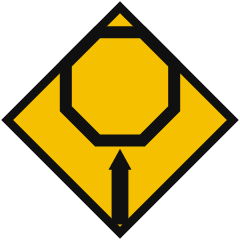
20. What is the driver expected to do after passing this sign?
Show answer
Answer A: Begin slowing so that a complete stop can be made at the intersection ahead
It is used where the control at the intersection stays hidden until late, so braking should begin here rather than at the stop line.
-
21. A person in a wheelchair is traveling in the roadway because the sidewalk is blocked by construction. What should you do?
Show answer
Answer B: Pass slowly with plenty of room, or wait
A blocked sidewalk leaves the person no choice but the road, and a chair cannot move aside quickly, so pass wide and slow or wait for room.
-
22. When must an Oregon driver file a collision report with DMV?
Show answer
Answer B: Within 72 hours if damage exceeds 2,500 dollars or anyone is injured or killed
Oregon requires a collision report within 72 hours when damage exceeds 2,500 dollars or when the crash caused injury or death.
-
23. Two left-turn lanes are marked at the intersection and you are in the left one. What must you do?
Show answer
Answer A: Stay in your own lane all the way around the turn
With dual turn lanes each driver must hold a lane through the whole turn and come out in the matching lane of the new street.
-
24. Where should you be looking as you steer through a turn?
Show answer
Answer C: Toward the point on the new road where you want to end up
Drivers steer toward what they look at, so looking through the turn to where you want to go keeps the path smooth and accurate.
-
25. What uninsured motorist coverage does Oregon require on a vehicle policy?
Show answer
Answer C: 25,000 dollars per person and 50,000 dollars per collision for bodily injury
Oregon requires uninsured motorist coverage of 25,000 dollars per person and 50,000 dollars per collision for bodily injury, mirroring the liability limits.
-
26. Why should you make sure your turn signal has stopped flashing after a lane change?
Show answer
Answer A: A signal left flashing tells other drivers that you intend to move again
Other drivers act on your signals, so one that is left on gives them false information about what you are about to do.
-
27. A pedestrian has stepped into a crosswalk at an intersection ahead of you. What is your obligation?
Show answer
Answer C: Yield and let the pedestrian finish crossing before you proceed
Drivers must yield to pedestrians in a crosswalk, and an intersection has a legal crosswalk whether or not lines are painted on the pavement.
-
28. The brake warning light stays on even though the parking brake is fully released. What does it indicate?
Show answer
Answer B: A possible brake system problem, so have the brakes checked promptly
The brake warning light also signals low brake fluid or a failure in one part of the hydraulic system. Do not ignore it, because braking may be reduced.
-
29. You are in the right-hand of two left-turn lanes and the vehicle beside you starts to drift toward your lane during the turn. What should you do?
Show answer
Answer B: Slow slightly, keep to your own lane and give the other vehicle room
Drivers commonly drift wide in dual turn lanes, so hold your own line, ease off and leave space rather than racing or crowding the other vehicle.
-
30. When is switching traction control off sometimes useful?
Show answer
Answer A: When you need spinning wheels to rock out of deep snow or mud
Rocking a stuck vehicle free needs the wheel spin that the system normally prevents. Switch it back on as soon as you are moving again.
-
31. At an intersection that uses a lagging left turn, when is the left-turn arrow displayed?
Show answer
Answer B: After the through movement has run
A lagging left turn phase runs at the end of the green rather than the start, so a driver waiting to turn should not assume the arrow has been missed.
-
32. Under Oregon's Milkman Mike Act framework, if a driver recklessly operates a vehicle and the resulting contact injures a person riding a bicycle or motorcycle, what offense results?
Show answer
Answer D: Vehicular assault, a Class A misdemeanor
ORS 811.060, named for the Milkman Mike Act, makes it vehicular assault, a Class A misdemeanor, when a driver recklessly operates a vehicle and the resulting contact causes physical injury to a bicyclist, motorcyclist, or pedestrian.
-
33. A train has just passed a crossing that carries more than one set of tracks. What should you do?
Show answer
Answer B: Wait until the warning devices stop and you can see clearly along every track
A passing train can hide a second one coming on another track, so wait for the signals to clear and check each track before moving.
-
34. On a long drive you notice repeated yawning, missed exits and drifting toward the lane line. What should you do?
Show answer
Answer C: Pull off at a safe place and sleep, or change drivers
Those are warning signs that sleepiness is already interfering with driving, and only rest restores alertness. Fresh air, music and caffeine do not reverse it.
-
35. Oregon's mandatory bicycle helmet law, unlike its motorcycle helmet law, applies to which riders?
Show answer
Answer D: Only a bicycle operator or rider under 16 years of age
ORS 814.485 requires only a bicycle operator or rider under 16 years of age to wear approved protective headgear, unlike Oregon's motorcycle helmet law, which applies to every rider regardless of age.