
Oregon DMV Permit Practice Test 7
Test 7 of 10. Pick an answer for each question to see if it is right and why; your score appears at the end. You need 28 correct answers to pass, the same ratio as the real Oregon test.
- Questions35
- Correct to pass28
- Passing score80%
- Minimum age15 years
-
1. You are turning left at an intersection and an oncoming bicyclist is approaching in the bike lane. What must you do?
Show answer
Answer B: Yield and complete the turn only after the bicyclist has passed
A bicycle in the roadway has the same right of way as a vehicle, so a left-turning driver must yield to an oncoming rider just as to an oncoming car.
-
2. A driver ahead brakes for no reason you can see, again and again. What should you do?
Show answer
Answer B: Increase your following distance and be ready for yet another stop
Unexplained braking tells you the driver is unsure or distracted, so the safe answer is more room, not less.
-
3. What blood alcohol concentration fails the test for an Oregon driver under 21?
Show answer
Answer A: Any amount at all
Oregon operates a zero tolerance law, so a driver under 21 fails the test with a blood alcohol concentration of any amount.
-
4. At the scene of a crash you were part of, what are you required to do besides stopping?
Show answer
Answer B: Give your name, your address and vehicle details, and help anyone who is hurt
Every state requires drivers involved in a crash to identify themselves and to render reasonable aid to anyone injured.
-
5. On a two-directional, two-lane Oregon highway where a lane change away from a stopped vehicle with hazard lights is not possible, what must a driver do?
Show answer
Answer D: Reduce speed to at least 5 miles per hour under the posted or designated speed limit
ORS 811.147 requires a driver on a two-directional, two-lane highway, where changing lanes away from a stopped vehicle displaying hazard or warning lights is not an option, to reduce speed to at least 5 mph under the posted or designated speed limit.
-
6. You enter a corner faster than the turn can be taken. What is the most likely result?
Show answer
Answer A: The vehicle runs wide and may cross into another lane
Excess speed uses up the available grip, so the vehicle follows a wider arc than intended and drifts out of its lane.
-
7. A pedestrian steps off the curb without looking your way. What should you assume?
Show answer
Answer B: That the person has not seen you at all, and be ready to stop for them
Defensive driving means assuming you have not been seen until there is clear evidence that you have.
-
8. What does Oregon law specifically prohibit regarding a fire department hose laid across a road during an emergency response?
Show answer
Answer D: Driving over an unprotected fire hose laid down on the road
ORS 811.150 prohibits a driver from driving over an unprotected fire department hose laid down on a highway, private road, or driveway.
-
9. In a work zone, the flagger's instructions conflict with the pavement markings still visible on the road. Which do you follow?
Show answer
Answer B: The flagger, because a person directing traffic outranks the markings
An authorized flagger controlling a temporary traffic control zone overrides signs, signals and markings, and drivers must obey the flagger's signals.
-
10. Two left-turn lanes are available and you must turn right again a short distance after the turn. Which of the two should you use?
Show answer
Answer D: The right one, so you finish nearer the right side of the new street
Each turn lane feeds the matching lane of the new street, so choosing the right-hand of the two left-turn lanes leaves you closer to the side you will need.
-
11. Under the Oregon Driver Manual, what is true about having a TV, tablet, or other video display in a moving vehicle?
Show answer
Answer D: It is illegal for such a display to be visible to the driver
The Oregon Driver Manual states it is illegal to have a TV, tablet, or other video display visible to the driver while driving.
-
12. What does the solid white line running along the right side of a highway mark?
Show answer
Answer A: The right edge of the traveled way
A solid white edge line shows where the traveled way ends on the right, which is particularly useful at night and in poor visibility.
-
13. What happens when tires are driven underinflated for a long time?
Show answer
Answer D: They wear at the edges, they run hot and they are more likely to fail
An underinflated tire flexes too much, which wears the shoulders and builds up heat that can destroy the tire.
-
14. You are turning left from a one-way street onto another one-way street. Which lane should you use?
Show answer
Answer B: Turn from the far left lane into the far left lane of the new street
The general turning rule is to turn from the lane nearest the direction of the turn into the nearest lane of the new roadway, which on a one-way to one-way left turn means far left to far left.
-
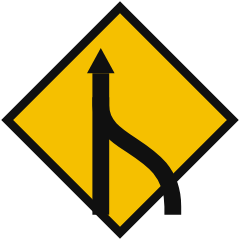
15. What is the safest way to deal with the situation this sign announces?
Show answer
Answer B: Match the speed of the other traffic stream and open a gap so vehicles can blend without hard braking
Blending works when speeds are matched and gaps are opened, so nobody has to brake hard or swerve where the two streams come together.
-
16. An overhead lane signal shows a flashing yellow X above your lane. What does it mean?
Show answer
Answer D: The lane may be used only for a left turn
A flashing yellow X marks a lane that may be used only to make a left turn; a steady yellow X is the one that warns you to leave the lane.
-
17. In a vehicle with automatic transmission, which foot should operate the brake and accelerator?
Show answer
Answer D: The right foot for both pedals
Using only the right foot prevents pressing both pedals at once and keeps the response the same in every vehicle you drive. The left foot rests on the floor or the footrest.
-
18. A pedestrian near the curb is staring at a phone and not looking at traffic. What should you do?
Show answer
Answer A: Slow down and be ready to stop, because the pedestrian may step out without looking
Distracted pedestrians step into the street without checking. Assume they have not seen you and give yourself time and space to stop.
-
19. The red oil pressure warning light comes on while you are driving. What should you do?
Show answer
Answer C: Pull over safely as soon as possible and shut off the engine
Loss of oil pressure means the engine is no longer being lubricated and can be destroyed within minutes. Stop, shut down and check before restarting.
-
20. Does Oregon's bicycle stop-as-yield law let a cyclist treat a steady, non-flashing red traffic light the same as a stop sign?
Show answer
Answer A: No, the stop-as-yield treatment only covers stop signs and flashing red signals, not a steady red light
ORS 814.414 and ORS 814.416 extend the stop-as-yield treatment only to stop signs and flashing red signals; a bicycle rider must still come to a complete stop and wait for a steady red traffic light to change.
-
21. How should a turn at an intersection be taken on a wet road?
Show answer
Answer C: Slow earlier than usual and steer smoothly through the corner
Wet pavement leaves less grip, so the speed must come off before the turn and the steering must be gentle enough not to break traction.
-
22. A sign with a brown background and a white legend guides road users to
Show answer
Answer B: parks, campgrounds and other recreational or cultural sites
Brown is reserved for recreational and cultural interest area signing, such as parks, historic sites and scenic areas.
-
23. What should you do about snow and ice on your vehicle before driving?
Show answer
Answer C: Clear all glass, mirrors and lights, and the roof and hood as well
Snow left on the roof or hood slides onto your windshield when you brake and blows into the path of drivers behind you, and covered lights make your vehicle hard to see.
-
24. You are crossing a divided highway with a wide median. How should you treat the two roadways?
Show answer
Answer D: As two intersections, waiting in the median only when your vehicle fits
Each roadway of a divided highway is a separate intersection, and you should wait in the median only if it is long enough to hold your vehicle clear of both roadways.
-
25. Under Oregon law, can a driver be convicted of DUII based solely on being under the influence of a controlled substance or an inhalant?
Show answer
Answer A: Only if that fact is specifically pleaded in the accusatory instrument and then proved at trial or admitted
ORS 813.010 allows a controlled-substance or inhalant DUII conviction only when that basis is specifically pleaded in the accusatory instrument and then proved at trial or admitted through a guilty plea.
-
26. Speed racing on an Oregon highway, including drag racing and exhibitions of speed, is classified as which offense?
Show answer
Answer C: A Class A traffic violation
ORS 811.125 makes speed racing, drag racing, and similar speed contests a Class A traffic violation, the most serious tier of traffic violation.
-
27. An Oregon driving privilege applicant under 18 generally needs a parent or legal guardian's signature on the application. When is that signature not required?
Show answer
Answer D: When the applicant is emancipated or married and provides proof of that status
The Oregon Driver Manual waives the parent or legal guardian signature requirement only when the under-18 applicant is emancipated or married and provides proof of that status.
-
28. What class of offense is reckless driving under Oregon law?
Show answer
Answer B: A Class A misdemeanor
ORS 811.140 makes reckless driving a Class A misdemeanor, a criminal offense rather than a traffic violation.
-
29. You are behind a snow plow working on a highway. What is the correct way to drive?
Show answer
Answer C: Stay well back and do not try to pass it
A plow throws snow, runs wider than its body and works on the poor surface ahead of it, so the cleared road behind it is the safest place to be.
-
30. A notification appears on your smart watch while you are driving. What should you do?
Show answer
Answer B: Treat it as you would a phone and leave it
A watch screen demands the same eyes and the same attention as a phone, and a wrist is no safer a place to read a message than a dashboard.
-
31. You are the first driver on a road just after a storm. What should you plan for?
Show answer
Answer B: Branches, mud and other debris hidden around the next bend
Storm debris lands where nobody has cleared it yet, often just beyond a curve or a crest, so reduce speed and look much further ahead.
-
32. Oregon's School Hours Speed Limit Sign requires the reduced 20 mph limit during which window on a day school is in session?
Show answer
Answer C: 7 a.m. to 5 p.m.
The Oregon Driver Manual states the School Hours Speed Limit Sign applies the 20 mph limit between 7 a.m. and 5 p.m. on a day school is in session.
-
33. You have turned onto a ramp at night and your headlights pick out large white arrows painted on the pavement pointing straight back at you. What do they mean?
Show answer
Answer C: You are traveling against the flow and must turn back
Wrong-way arrows are laid so that a driver going the correct way never sees them head on, so an arrow pointing at you means you are on the ramp backwards.
-
34. A yellow diamond showing the silhouette of a deer warns that
Show answer
Answer D: large animals may cross the road in that area
The sign marks a stretch where animals are known to cross, so drivers should reduce speed and scan both roadsides, especially around dawn and dusk.
-
35. How much clear road do driver manuals say you need before starting a pass at highway speed on a two-lane road?
Show answer
Answer C: Enough to complete the pass and return, roughly ten to twelve seconds of travel
At highway speed the whole maneuver of pulling out, overtaking and returning takes roughly ten to twelve seconds, and every foot of that has to be visible before you start.