
Oregon DMV Motorcycle Practice Test 4
Test 4 of 6. Pick an answer for each question to see if it is right and why; your score appears at the end. You need 20 correct answers to pass, the same ratio as the real Oregon test.

- Questions25
- Correct to pass20
- Passing score80%
- Minimum age16 years
-
1. If a driver causes or contributes to a crash while violating Oregon's driving-uninsured law, what suspension does DMV impose?
Show answer
Answer C: A one-year suspension, not lifted until future responsibility filing requirements are met
ORS 809.417 requires DMV to suspend the driving privileges of a person who was driving uninsured at the time of a crash for one year, and DMV will not reinstate privileges until future responsibility filing requirements are satisfied.
-
2. Under Oregon's Milkman Mike Act framework, if a driver recklessly operates a vehicle and the resulting contact injures a person riding a bicycle or motorcycle, what offense results?
Show answer
Answer D: Vehicular assault, a Class A misdemeanor
ORS 811.060, named for the Milkman Mike Act, makes it vehicular assault, a Class A misdemeanor, when a driver recklessly operates a vehicle and the resulting contact causes physical injury to a bicyclist, motorcyclist, or pedestrian.
-
3. In Oregon, careless driving is normally a Class B traffic violation. What happens to its classification if the careless driving contributes to a crash?
Show answer
Answer D: It becomes a Class A traffic violation, the most serious traffic violation tier
ORS 811.135 upgrades careless driving from a Class B to a Class A traffic violation when the offense contributes to an accident.
-
4. You enter a corner faster than the turn can be taken. What is the most likely result?
Show answer
Answer A: The vehicle runs wide and may cross into another lane
Excess speed uses up the available grip, so the vehicle follows a wider arc than intended and drifts out of its lane.
-
5. Two roads come together at a shallow angle under a MERGE sign, with no yield line on either one. What is expected of you?
Show answer
Answer D: Adjust your speed and position so you blend smoothly into the other traffic
A merge means neither road ends at a stop; drivers adjust speed and position so that the two streams fit together without stopping.
-
6. Which restriction applies to an Oregon motorcycle instruction permit holder?
Show answer
Answer C: Riding is limited to daylight hours, with no passengers, accompanied by an endorsed rider at least 21 years old on a separate motorcycle
An Oregon motorcycle permit holder must ride during daylight only, may not carry passengers, must wear a DOT compliant helmet and must be supervised by a rider at least 21 years old with a valid motorcycle endorsement on a separate motorcycle.
-
7. In Oregon, refusing to take a breath or urine test for intoxicants when lawfully requested carries what specific consequence, on top of any license action?
Show answer
Answer C: A presumptive fine of $650
ORS 813.095 classifies refusal to take a test for intoxicants as a specific fine traffic violation with a presumptive fine of $650, in addition to license consequences.
-
8. How should a rider and passenger arrange to communicate during a ride?
Show answer
Answer A: By agreeing on simple signals or taps before the ride starts
Wind and engine noise make speech unreliable, so a short set of signals agreed in advance is the dependable way for a passenger to say they need to stop.
-
9. When does Oregon require headlights to be turned on?
Show answer
Answer A: From sunset to sunrise, and any time you cannot see vehicles 1,000 feet ahead
Oregon requires headlights from sunset to sunrise and at any other time when conditions prevent you from seeing vehicles 1,000 feet ahead.
-
10. What class of Oregon driver license is required to operate an autocycle?
Show answer
Answer B: Any class of driver license; no motorcycle endorsement is required
Oregon's Motorcycle and Moped Manual states an autocycle may be operated with any class of driver license, and a motorcycle endorsement is not required.
-
11. Why should a load never be fastened to the handlebars or the front forks?
Show answer
Answer D: The weight upsets the steering and makes the front end handle unpredictably
Anything hung on the steering moves with it and changes how the motorcycle turns, which is why loads belong low and behind the rider instead.
-
12. Traffic is backed up just past the exit you want to use at a single-lane roundabout. What should you do?
Show answer
Answer D: Wait at the yield line until you can pass through and exit
You must not enter a roundabout unless you can clear it, because stopping inside blocks every other entry.
-
13. A driver in the left lane of a freeway realizes only when level with this sign that the ramp beside it is the one they need. What is the correct action?
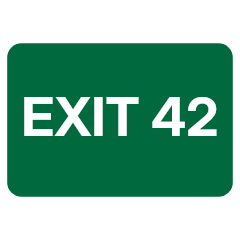
Show answer
Answer A: Carry on to the next interchange and turn back from there
There is no safe way back to a ramp once it has been reached from the wrong lane, so the driver keeps going to the next interchange, where the ramps are built for that movement.
-
14. On an Oregon road with two or more lanes in your direction, what must you do when approaching a stopped vehicle with its lights flashing?
Show answer
Answer B: Change lanes so you do not drive next to it, or slow down by at least 5 mph under the posted limit
Oregon requires drivers to change lanes away from any stopped vehicle showing flashing lights, or to reduce speed by at least 5 miles per hour under the posted limit when a lane change is not possible.
-
15. A square sign with a red field, a wide white horizontal bar and the words DO NOT ENTER tells a driver that
Show answer
Answer B: the roadway ahead must not be entered from that point
The do not enter sign is posted at the end of a one-way roadway or ramp to keep traffic from driving into it against the flow.
-
16. In which crash must the police always be notified?
Show answer
Answer D: Any crash in which somebody has been injured or killed, whatever the damage
Injury or death always makes a crash reportable, whatever the amount of vehicle damage or the opinions of the drivers.
-
17. Where is signing of this kind normally placed along a freeway?
Show answer
Answer D: Ahead of the interchange and again at the exit, so a driver can reach the correct lane in time
Guide information for an interchange is repeated on the approach and at the ramp, because a driver who learns about the exit only at the last moment has no room left for a safe lane change.
-
18. What is the recommended minimum following distance behind the vehicle ahead?
Show answer
Answer C: Two seconds
A two second gap is the minimum in good conditions and should be stretched to three seconds or more on slippery roads, in poor visibility or in heavy traffic.
-
19. How does a rider judge whether the brake pads still have life left in them?
Show answer
Answer A: By looking at how much friction material is left on the pad
Pads are inspected visually for remaining thickness against the wear indicator, because a pad worn to its backing plate will destroy the disc.
-
20. If an Oregon driver fails to file a required accident report, how long does the resulting DMV suspension of driving privileges continue?
Show answer
Answer B: Until the report is filed, or five years from the suspension date, whichever comes sooner
ORS 809.417 continues a suspension for failing to file a required accident report until the person files the report, or for five years from the date of suspension, whichever comes sooner.
-
21. Under Oregon law, a two-wheeled vehicle capable of exceeding 30 mph unassisted on level ground no longer qualifies as a moped and instead requires what?
Show answer
Answer A: A motorcycle endorsement, because it must be licensed and operated as a motorcycle
Oregon's Motorcycle and Moped Manual explains that a moped cannot exceed 30 mph unassisted on level ground; a two-wheeled vehicle that can go faster must be licensed and operated as a motorcycle, requiring a motorcycle endorsement.
-
22. A regulatory sign posted at the start of a road reads LENGTH LIMIT 30 FEET. What does it control?
Show answer
Answer B: The overall length of vehicle allowed on that road
Some states post a length limit where tight curves or narrow structures lie ahead; it bars vehicles or combinations longer than the figure shown from using that road.
-
23. What does Oregon law allow and prohibit regarding lane sharing on a motorcycle?
Show answer
Answer C: Two motorcycles may ride abreast in a single lane, but riding between rows of vehicles is illegal
Oregon permits two motorcycles to ride abreast in a single lane, but riding between rows of stopped or moving vehicles, commonly called lane splitting, is illegal in Oregon.
-
24. What is the PRIME position on a fuel supply valve used for?
Show answer
Answer D: To let fuel flow into the carburetor after the machine has stood unused
PRIME bypasses the normal vacuum control and lets fuel refill an empty carburetor, which helps a machine start after sitting for a long time.
-
25. Oregon's School Hours Speed Limit Sign requires the reduced 20 mph limit during which window on a day school is in session?
Show answer
Answer C: 7 a.m. to 5 p.m.
The Oregon Driver Manual states the School Hours Speed Limit Sign applies the 20 mph limit between 7 a.m. and 5 p.m. on a day school is in session.