
Oregon DMV Motorcycle Practice Test 1
Test 1 of 6. Pick an answer for each question to see if it is right and why; your score appears at the end. You need 20 correct answers to pass, the same ratio as the real Oregon test.

- Questions25
- Correct to pass20
- Passing score80%
- Minimum age16 years
-
1. What does Oregon's Implied Consent law mean for a driver stopped by police?
Show answer
Answer D: By driving, the person has agreed to take a breath, blood or urine test when asked by an officer
Under Oregon's Implied Consent law the act of driving is itself agreement to submit to a breath, blood or urine test, and refusal can bring a fine and suspension of driving privileges.
-
2. You are already inside an intersection when you realize you should be in the lane beside you. What should you do?
Show answer
Answer C: Stay in your lane through the intersection and change lanes afterwards
Drivers in an intersection are watching for cross traffic and turning vehicles, so an unexpected sideways move there is easily missed.
-
3. At an intersection where turning on a red arrow is not permitted, the signal shows a red left arrow next to a steady green ball. What may you do?
Show answer
Answer D: Go straight or turn right if permitted, but not left
An arrow controls only the movement it points to, so here the red arrow stops the left turn while the green ball still allows the other movements.
-
4. Does Oregon's move-over / safe-distance statute apply only to police cars and other government emergency vehicles that are stopped?
Show answer
Answer C: No, it applies to any stopped vehicle displaying required warning or hazard lights, or emergency flares or signs
ORS 811.147 is written broadly to cover any stopped motor vehicle displaying required warning or hazard lights, or a person indicating distress with emergency flares or signs, not just government emergency vehicles.
-
5. What does Oregon law specifically prohibit regarding a fire department hose laid across a road during an emergency response?
Show answer
Answer D: Driving over an unprotected fire hose laid down on the road
ORS 811.150 prohibits a driver from driving over an unprotected fire department hose laid down on a highway, private road, or driveway.
-
6. According to the Oregon Driver Manual, when may a driver turn in front of a streetcar or light rail train traveling in the same direction from an adjacent lane?
Show answer
Answer A: Never, even if the streetcar or train is currently stopped
The Oregon Driver Manual instructs drivers to never turn in front of a streetcar or light rail train traveling in the same direction from an adjacent lane, even if the streetcar or train is currently stopped.
-
7. You are approaching a blind left hand curve. Which starting lane position gives the best view through it?
Show answer
Answer C: The right portion of your lane
On a left hand bend the outside of the lane is the right side, and moving there lets the rider see farther around the curve before entering it.
-
8. Which feature suggests that a helmet is an uncertified novelty helmet?
Show answer
Answer D: A shell less than one inch thick with no firm foam liner
Novelty helmets are typically thin and very light because they lack the stiff energy absorbing liner that a certified helmet uses to manage an impact.
-
9. A steady red arrow is displayed for your left-turn lane at a two-way intersection. What must you do?
Show answer
Answer C: Stop and remain stopped until an indication permits the turn
A steady red arrow prohibits the movement it points to, so the driver stops and waits for a green arrow, a flashing yellow arrow or another indication that permits the turn.
-
10. Oregon's Schedule II suspension periods for certain repeat driving offenses within a five-year window escalate in which pattern?
Show answer
Answer C: 1 year first offense, 3 years for a repeat within five years
ORS 809.428 sets Schedule II at 1 year for a first offense and 3 years for a second or any subsequent offense committed within a five-year period.
-
11. Which organization is Oregon's only approved provider of motorcycle rider education courses?
Show answer
Answer D: Team Oregon
Oregon's Motorcycle and Moped Manual identifies Team Oregon as the only approved motorcycle rider education provider in the state.
-
12. Under Oregon's habitual offender law, how many convictions for major offenses such as DUII, reckless driving, or fleeing a police officer, committed within a five-year period, will get a person's driving privileges revoked?
Show answer
Answer D: Three or more convictions within a five-year period
ORS 809.600 revokes driving privileges as a habitual offender once a person is convicted three or more times, within a five-year period, of major offenses such as DUII, reckless driving, or fleeing a police officer.
-
13. Where is a strong crosswind most likely to hit you suddenly?
Show answer
Answer D: Coming out of a tunnel or a cut onto an open bridge
Gusts arrive the moment you leave shelter, which is why bridge approaches and the ends of cuts and tunnels catch drivers out.
-
14. You have stopped on the shoulder of a busy freeway with a flat tire that you cannot change safely. Where should you and your passengers wait?
Show answer
Answer A: Well away from the traffic side, behind a barrier or up the bank if there is one
People struck on the shoulder are a common cause of roadside deaths, so wait away from the traffic side and behind any barrier.
-
15. You are in the open lane where another lane is merging into yours. What is your part in the merge?
Show answer
Answer A: Keep a steady speed and leave a gap for one vehicle to come in
A merge works when each driver in the through lane lets one vehicle in, which keeps both lines moving instead of stopping them both.
-
16. You are entering a marked school zone during the posted hours. What should you do?
Show answer
Answer A: Slow to the school zone limit and watch for children
The school zone limit applies throughout the posted hours, whether or not you can see any children at that moment.
-
17. A pedestrian signal changes to a flashing upraised hand. What does that indication mean?
Show answer
Answer C: Do not start crossing, but finish a crossing already begun
The flashing upraised hand is the pedestrian change interval: nobody may start to cross, but a pedestrian already in the crosswalk may continue to the far side or to a median.
-
18. A yellow diamond showing the silhouette of a deer warns that
Show answer
Answer D: large animals may cross the road in that area
The sign marks a stretch where animals are known to cross, so drivers should reduce speed and scan both roadsides, especially around dawn and dusk.
-
19. A new DUII charge becomes a Class C felony in Oregon if the person has how many prior DUII convictions within how many years of the current offense?
Show answer
Answer B: Two or more prior convictions within 10 years
ORS 813.011 elevates DUII to a Class C felony once the defendant has at least two prior DUII convictions, in any combination of jurisdictions, within the 10 years before the current offense.
-
20. On an Oregon highway posted at 65 mph or greater, exceeding the limit by more than 10 but not more than 20 mph is punishable as which class of violation?
Show answer
Answer C: Class B traffic violation
ORS 811.109 sets a different tiering for highways posted at 65 mph or above: up to 10 mph over is Class C, 11 to 20 mph over is Class B, and more than 20 mph over is Class A.
-
21. In Oregon, can a driver be cited for violating the basic speed rule even while driving below the speed that would normally be prima facie evidence of a violation?
Show answer
Answer A: Yes, because the basic speed rule independently requires a speed that is reasonable and prudent for the conditions
ORS 811.100 makes violating the basic speed rule a Class B traffic violation even at a speed below the prima facie threshold in ORS 811.105, because the rule is about safe conditions, not a fixed number.
-
22. No plaque stating days or hours accompanies this sign at the intersection. When does the restriction apply?
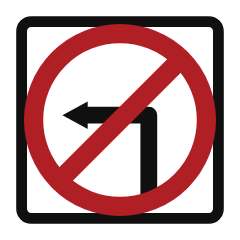
Show answer
Answer D: At all times, since nothing limits it to particular periods
A regulatory restriction runs continuously unless a supplemental plaque states the days or hours during which it applies.
-
23. What is the correct swerving technique?
Show answer
Answer D: Press the handgrip on the side you want to go and look toward the escape route
A swerve is two quick countersteering inputs, and because the motorcycle goes where the rider looks, the eyes belong on the open space.
-
24. Once a person is sentenced for a Class C felony DUII in Oregon, what mandatory minimum incarceration term applies, without reduction for any reason?
Show answer
Answer C: 90 days
ORS 813.011 requires a mandatory minimum of 90 days of incarceration for a felony DUII conviction, and that minimum cannot be reduced for any reason.
-
25. In Oregon, if a driver has valid insurance but simply does not have proof of it in the vehicle when stopped, what is true about the resulting citation?
Show answer
Answer D: It is dismissed if proof of coverage is delivered before the court date
ORS 806.012 makes failing to carry proof of financial responsibility a Class B traffic violation, but the court must dismiss the charge if the person delivers proof of compliance to the court clerk before the scheduled court date.