
Oregon DMV Motorcycle Practice Test 50
- Questions25
- Correct to pass20
- Passing score80%
- Minimum age16 years
-
1. You feel fine twenty minutes after your last drink. Why is that a poor guide to driving?
Show answer
Answer B: Your blood alcohol level can still be rising
Alcohol keeps being absorbed for some time after the last drink, so a driver who feels able at the door can be more impaired a few miles down the road.
-
2. How long should a head check before a lane change last?
Show answer
Answer D: A quick glance, so you do not lose track of what is happening ahead
Traffic ahead can change in a second, so the blind spot check is a fast glance and the rider returns attention to the road immediately.
-
3. You are turning left into a street that is divided by a raised median. Which side should you enter?
Show answer
Answer C: The right-hand roadway, so that you travel on the proper side
A raised median separates two directions of travel, so the turn must be completed into the roadway carrying traffic your way.
-
4. How does braking distance change if you double your speed?
Show answer
Answer D: It grows much more than twice as long
Braking distance increases with the square of speed, so doubling speed roughly quadruples the distance needed to stop.
-
5. A vehicle ahead of you displays a reflective orange triangle on its rear. What does that emblem tell you?
Show answer
Answer B: The vehicle is built to travel at 25 mph or less
The orange triangle is the slow moving vehicle emblem used on farm and construction equipment designed for 25 mph or less, warning you that you are closing on it much faster than it appears.
-
6. Your right-turn lane shows a green arrow while the through lanes face a red ball. What does that mean?
Show answer
Answer C: Only the right turn is allowed, and it is protected while the arrow lasts
A green arrow gives a protected movement in that direction only; the red ball still stops the through traffic in the other lanes.
-
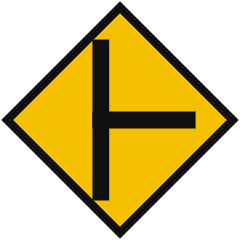
7. What condition does this sign warn a driver about?
Show answer
Answer B: Another road joins the road being traveled, from one side
It announces a side road entering the main roadway, so the driver should expect vehicles waiting to pull out and other vehicles slowing to turn in.
-
8. A flagger turns the paddle to the orange face reading SLOW. What does that tell approaching drivers?
Show answer
Answer D: Reduce speed and continue through the work area with care
The SLOW face keeps traffic moving at a reduced speed while workers or equipment are close to the travel lanes.
-
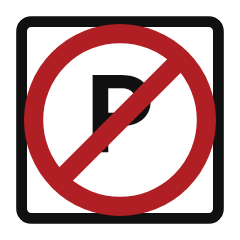
9. Why is this restriction so common beside fire hydrants, crosswalks and intersection corners?
Show answer
Answer C: To keep sight lines open and leave access for emergency crews
A vehicle left in those places hides pedestrians from approaching drivers, blocks the path of turning vehicles and can keep firefighters from reaching a hydrant.
-
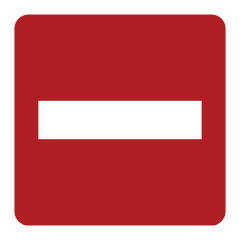
10. A driver hunting for an on-ramp meets this sign at the mouth of the pavement ahead. What is the correct action?
Show answer
Answer C: Keep out of that roadway and look for the proper approach elsewhere
The restriction is absolute and does not depend on how much traffic is present, so the driver has to reach the highway by an approach built for entering vehicles.
-
11. Once you are moving, which way of using a navigation device costs you the least attention?
Show answer
Answer B: Listening to the spoken directions
Voice guidance lets you keep your eyes on the road, while anything that needs the screen takes glances that add up over a trip.
-
12. A strong wind is blowing across an open stretch of road. Besides the gusts, what else should you watch for?
Show answer
Answer A: Branches, dust and loose objects blown into your path
High wind strips branches, litter and dust onto the roadway and can push other vehicles out of their lane, so scan much further ahead than usual.
-
13. Which ability does alcohol usually affect first?
Show answer
Answer A: Judgment and self control
Alcohol reduces judgment and inhibition before a drinker notices any clumsiness, which is why an impaired driver often feels perfectly capable while already driving worse.
-
14. Halfway through a curve you realize you are going too fast. What is the best response?
Show answer
Answer C: Ease off the gas gently and look where you want to go
Easing off transfers a little weight to the front tires without upsetting the balance, and looking through the curve keeps your steering smooth.
-
15. You have a steady green ball to turn left, and the oncoming traffic gets a green left arrow. What does that mean for you?
Show answer
Answer C: Oncoming vehicles will turn across your path, so you must wait
A green ball is permissive, so when the oncoming side receives a protected arrow those vehicles have priority and you must yield until they clear.
-
16. Which sequence describes a well-made turn?
Show answer
Answer A: Signal, move into the correct lane, slow down, check, then turn
Tell others first, take your position, lose the speed before the corner, take a final look, and only then steer through the turn.
-
17. A high-occupancy vehicle lane is separated from the general lanes by a pair of solid white lines with a gap every so often. Where may you enter or leave it?
Show answer
Answer D: Only at the openings where the solid lines are broken
The solid lines forbid crossing, so entry and exit are limited to the designated openings where the marking is broken.
-
18. You have a green light and an ambulance with lights and siren enters the intersection against its red. What should you do?
Show answer
Answer B: Stop and let the ambulance go through
An emergency vehicle answering a call may cross against a red, and every other driver yields to it whatever their own signal shows.
-
19. What should a rider look for in rain gear?
Show answer
Answer A: A riding rain suit that fits close and will not balloon or tear at speed
Rain gear designed for riding stays sealed and stays put in the airstream, while loose garments can flap, tear or interfere with the controls.
-
20. Children are playing close to the edge of a residential street. What is the right speed choice?
Show answer
Answer D: Well below the limit, slow enough to stop for a sudden dash
Children can step out without warning, so the safe speed is the one that lets you stop within the distance you can see to be clear.
-
21. The rider behind you is closing right up on your machine and crowding you. What is the best response?
Show answer
Answer D: Let them go past and take a position behind them instead
Speeding up to escape a rider who is following too closely usually brings them with you, while letting them past removes the pressure entirely.
-
22. On an overhead guide sign, the small exit number panel sits above the left-hand end rather than the right. What does that placement tell you?
Show answer
Answer A: The exit leaves from the left side of the roadway
The exit number plaque is placed on the side from which the ramp leaves, which gives advance notice of the unusual left-hand exit.
-
23. You spot a deep pothole that the riders behind you will not be able to see until it is too late. What is the usual way to warn them?
Show answer
Answer B: Point at it with a hand or a foot on the side it lies on
Pointing at the hazard on the correct side tells the riders behind both that something is there and where in the lane it is.
-
24. An oncoming vehicle at night has its high beams on and you are being dazzled. Where should you look?
Show answer
Answer A: Toward the right edge of your lane
Looking toward the right edge line keeps you on course while sparing your eyes the worst of the glare. Slow down and do not retaliate with your own high beams.
-
25. A large X with the letters R and R beside it is painted across your lane. What does it mean?
Show answer
Answer A: A railroad crossing lies a short distance ahead
The pavement marking repeats the advance warning for a grade crossing, and it is used on paved approaches where speeds are high or where gates are installed.