
Oregon DMV Permit Practice Test 25
- Questions35
- Correct to pass28
- Passing score80%
- Minimum age15 years
-
1. What does a sign reading Slower Traffic Keep Right require?
Show answer
Answer C: Traffic moving slower than the general flow must use the right-hand lane
The sign applies to any vehicle traveling below the speed of the traffic around it, which must keep right so faster vehicles can use the lanes to the left.
-
2. An emergency vehicle with flashing lights and a siren is approaching from behind on a two-way street. What should you do?
Show answer
Answer C: Pull over to the right edge of the road and stop until it passes
Clearing a path by pulling to the right and stopping gives the emergency vehicle a predictable route, while stopping in mid-lane or inside an intersection blocks that path.
-
3. Is dictating a message by voice a safe alternative to typing one?
Show answer
Answer C: No, it still takes attention from driving
Composing and checking a spoken message loads the mind and usually pulls the eyes to the screen anyway, so research finds it no safer than other phone use.
-
4. Your left-turn lane faces a steady green ball and oncoming traffic is heavy. What are you allowed to do?
Show answer
Answer C: Move into the intersection and turn when a safe gap appears
A green ball permits the turn but gives no priority, so you may move into the intersection and wait there for a gap in the oncoming traffic.
-
5. Why should cruise control be switched off on wet, snowy or icy roads?
Show answer
Answer B: It may keep feeding power to a wheel that has started to slip, and cancelling it costs you time
Cruise control holds a set speed regardless of grip, so it can add power just as a tire loses traction, and the extra step of cancelling it delays your response.
-
6. What does the implied consent law mean for drivers?
Show answer
Answer D: By driving, you have agreed to a chemical test if lawfully arrested for impaired driving
Holding a license and driving on public roads is treated as consent to breath, blood or urine testing when an officer has grounds to arrest you. Refusing normally brings its own license penalties.
-
7. You are turning right off a street into a parking lot driveway that crosses a bike lane and a sidewalk. Who has the right of way?
Show answer
Answer D: Pedestrians on the sidewalk and riders in the bike lane
Turning into a driveway means crossing the paths of people who were already traveling straight, so you give way to both the bike lane and the sidewalk.
-
8. A motorcycle ahead of you is weaving slightly as it crosses a stretch of grooved pavement. What should you do?
Show answer
Answer D: Give the rider extra room until the surface improves
Grooves, metal plates and loose material affect a motorcycle far more than a car, so back off and let the rider deal with the surface.
-
9. A small plate under a stop sign reads CROSS TRAFFIC DOES NOT STOP. What is it telling you?
Show answer
Answer D: Traffic on the cross street is not required to stop at all
The plate warns that the other road is uncontrolled, so you must wait for a gap instead of expecting anyone to take turns with you.
-
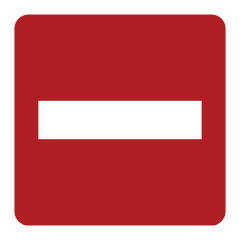
10. A driver hunting for an on-ramp meets this sign at the mouth of the pavement ahead. What is the correct action?
Show answer
Answer C: Keep out of that roadway and look for the proper approach elsewhere
The restriction is absolute and does not depend on how much traffic is present, so the driver has to reach the highway by an approach built for entering vehicles.
-
11. What is lane splitting?
Show answer
Answer B: A motorcycle riding between two lanes of traffic moving the same way
Lane splitting means riding along the line between two lanes of traffic going in the same direction rather than staying within a lane.
-
12. What does the traffic law actually say about the right of way?
Show answer
Answer B: It says who must yield; no driver is ever entitled to take the right of way
The law describes who must yield. Right of way is something you give; insisting on it when another driver does not yield causes crashes.
-
13. You are turning right on a red light where that is permitted. What does the law require first?
Show answer
Answer B: A full stop, then yielding to traffic and pedestrians
A right turn on red is allowed only after stopping completely and giving way to everyone who has the green, including people in the crosswalk.
-
14. Another vehicle is passing you on a two-lane road. What should you do with your speed?
Show answer
Answer A: Hold your speed or ease off slightly to shorten the pass
Speeding up strands the passing driver in the oncoming lane, while a steady speed or a slight lift lets the pass finish quickly and safely.
-
15. You enter a work zone at night where one lane is closed and a flagger is on duty. What is the safest approach?
Show answer
Answer A: Slow early, merge before the closure and be ready to stop
Merging early at a reduced speed keeps the queue orderly and leaves you room to stop for equipment, workers or traffic that has halted ahead.
-
16. The lane control signal above your lane changes to a steady yellow X. What should you do?
Show answer
Answer A: Prepare to leave the lane, because it is about to be closed
A steady yellow X is the warning that the lane below it is about to close, giving drivers time to move over before the red X appears.
-
17. When should you enter a destination into a navigation device?
Show answer
Answer B: Before you start driving, or after parking in a safe place
Programming a route is a visual, manual and mental task at the same time, so it belongs to the moments before the vehicle moves rather than to any point in traffic.
-
18. Where is a U-turn most clearly unsafe and generally prohibited?
Show answer
Answer D: On a curve or near a hill crest, where other drivers cannot see you
U-turns are barred where approaching drivers cannot see you in time, such as on a curve or near the top of a hill.
-
19. Why can an oncoming vehicle that looks comfortably far away leave you far less room than you expect?
Show answer
Answer D: You and that vehicle close the gap at the sum of both your speeds
Two vehicles approaching at 55 mph each close the distance between them at about 110 mph, so the gap disappears in half the time you would expect.
-
20. When should you turn on your signal before a turn or a lane change?
Show answer
Answer C: Well before the maneuver, so other drivers have time to react
A signal is a warning to others, so it has to be given far enough ahead of the maneuver that drivers and pedestrians can adjust.
-
21. Something rolls off the seat onto the floor while you are driving. What should you do?
Show answer
Answer C: Leave it where it is and pick it up after you stop somewhere safe
Reaching for an object pulls your eyes and your body away from the controls at exactly the wrong moment, and nothing on the floor is worth that risk.
-
22. A center lane is bordered by a solid yellow line on the outside and a broken yellow line on the inside, with turn arrows painted inside it. What is that lane for?
Show answer
Answer C: Left turns made by traffic traveling in either direction
That marking pattern identifies a two-way left-turn lane, which drivers approaching from both directions may use to prepare for a left turn.
-
23. At what blood alcohol concentration does Oregon law presume that a driver 21 or older is impaired?
Show answer
Answer C: 0.08 percent
Oregon presumes impairment at a blood alcohol concentration of 0.08 percent or more, although a driver may still be arrested for DUII at a lower level.
-
24. The street you are turning right onto has a bike lane along its right edge. Where should your vehicle end up?
Show answer
Answer B: In the first traffic lane to the left of the bike lane
A bike lane is not a travel lane for motor vehicles, so the nearest lane you may finish a right turn in is the first general traffic lane beside it.
-
25. Traffic safety experts describe three kinds of driver distraction. Which set is correct?
Show answer
Answer A: Visual, manual and cognitive
Distraction takes the eyes off the road, the hands off the controls or the mind off driving, and many activities do more than one of those at once.
-
26. Why is an underinflated tire especially risky on a long drive in hot weather?
Show answer
Answer C: It flexes more, builds up heat and can fail at speed
A soft tire flexes on every rotation, and that flexing makes heat that the hot road and high speed add to until the tire can come apart.
-
27. The motorcyclist ahead of you keeps moving from one side of the lane to the other. What should you understand?
Show answer
Answer B: The rider is avoiding surface hazards and staying where drivers can see the bike
Riders shift their lane position to avoid debris, grease strips and potholes and to be seen. That movement is normal and never an invitation to share the lane.
-
28. Why should your thumbs rest along the rim rather than hook inside the spokes?
Show answer
Answer D: A jolt can spin the wheel and injure hooked thumbs
A pothole or a dropped wheel can snap the wheel round violently, and thumbs hooked through the spokes are trapped when it happens.
-
29. A short driver cannot get ten inches between the chest and the steering wheel airbag. What is the answer?
Show answer
Answer D: Move the seat back and tilt the wheel downward, or fit pedal extenders
Distance from the airbag is gained by moving the seat back and aiming the wheel at the chest, using pedal extenders if the pedals are then out of reach.
-
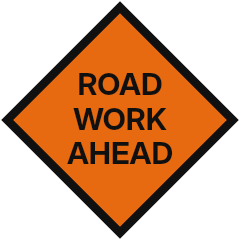
30. This sign is still standing late at night, and nobody is working. What should the driver assume?
Show answer
Answer B: The layout may still be altered, so the same care and reduced speed apply
Narrowed lanes, shifted alignments, dropped pavement edges and parked equipment remain overnight, so the hazard does not end when the crew goes home.
-
31. Your wiper blades smear the windshield instead of clearing it. What should you do?
Show answer
Answer C: Replace the blades, because smearing means that the rubber is worn
Worn or hardened rubber cannot wipe cleanly, and blades are cheap compared with driving without a clear view.
-
32. A snow squall cuts visibility to almost nothing while you are on a highway. What must you not do?
Show answer
Answer D: Stop in a travel lane and wait for the squall to blow through
A vehicle stopped in a lane in a whiteout is invisible until someone hits it. Slow gradually and keep moving until you can leave the roadway completely.
-
33. What are painted curb markings mainly used for?
Show answer
Answer D: Conveying parking and stopping regulations
Colored curbs tell drivers where waiting or parking is restricted, and because the exact color meanings are set locally a driver should also read the posted signs.
-
34. When may you stop on the shoulder of a freeway?
Show answer
Answer A: Only in an emergency, moving completely off the travel lanes and switching on your hazard lights
The freeway shoulder is reserved for emergencies and for disabled vehicles, and a vehicle stopped there must be clear of the travel lanes with hazard lights on.
-
35. You drive onto a section where the top layer has been milled off and the surface is grooved. How will it feel?
Show answer
Answer C: The steering may wander, so hold the wheel firmly and slow down
Grooves cut into the pavement tug at the tires and make the steering feel restless. A firm grip and a lower speed keep the vehicle tracking straight.