
Oregon DMV Permit Practice Test 24
- Questions35
- Correct to pass28
- Passing score80%
- Minimum age15 years
-
1. You have stopped after a crash. Why should the engines of the vehicles involved be switched off?
Show answer
Answer A: To reduce the risk of a fire starting around any fuel that has spilled
Crashes often break fuel lines, and a running engine is a source of ignition, so switching off lowers the risk of fire.
-
2. You are crossing a divided highway with a wide median. How should you treat the two roadways?
Show answer
Answer D: As two intersections, waiting in the median only when your vehicle fits
Each roadway of a divided highway is a separate intersection, and you should wait in the median only if it is long enough to hold your vehicle clear of both roadways.
-
3. What belongs in a basic emergency kit carried in a car?
Show answer
Answer D: A flashlight, a first aid kit, jumper cables and some warning devices
A useful kit lets you see, be seen, treat an injury and restart the vehicle; carrying loose gasoline is a fire risk.
-
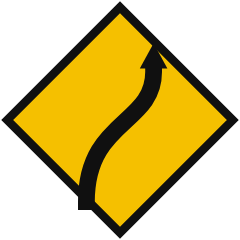
4. What does this sign tell a driver about the road ahead?
Show answer
Answer A: The roadway changes direction ahead, so speed should be reduced before reaching it
It gives advance notice of a change in alignment so the driver can slow down before entering, since braking inside a bend uses up grip that is needed for steering.
-
5. At roughly what speed can hydroplaning begin when a lot of water is lying on the road?
Show answer
Answer C: At speeds as low as about 35 mph
With enough water and less than perfect tread, a tire can start to ride on the water at around 35 mph, well below normal highway speeds.
-
6. On a street with parking along the curb, the shared lane marking is painted well out from the curb face. What does that placement tell a bicyclist?
Show answer
Answer C: To ride clear of the doors of parked cars
The marking is set at least eleven feet from the curb where parking is allowed so that riders are guided outside the reach of an opening door.
-
7. Why is the road often most slippery during the first few minutes of rain after a long dry spell?
Show answer
Answer C: Oil and dust on the surface mix with the water into a slick film
Oil drippings and road dust build up on dry pavement, and the first light rain lifts them into a slippery film before heavier rain washes it away.
-
8. A pedestrian is waiting to cross ahead of you and you have slowed down. What helps most?
Show answer
Answer D: Making eye contact, so that you both know you have seen each other
Eye contact confirms that you have seen each other; waving someone across can send them into the path of another vehicle.
-
9. Halfway through a curve you realize you are going too fast. What is the best response?
Show answer
Answer C: Ease off the gas gently and look where you want to go
Easing off transfers a little weight to the front tires without upsetting the balance, and looking through the curve keeps your steering smooth.
-
10. What is the purpose of carrying a first aid kit in your vehicle?
Show answer
Answer D: It lets you treat cuts and bleeding while the help is on its way
A kit is for simple first aid such as controlling bleeding until trained help arrives, not a substitute for calling for that help.
-
11. You are behind three slow vehicles on a two-lane road and the way ahead looks clear. What is the sound decision?
Show answer
Answer D: Pass one vehicle at a time, if the road allows it
Passing several vehicles in one move keeps you in the oncoming lane far too long and leaves nowhere to go if a vehicle appears.
-
12. Your vehicle breaks down on a busy highway. What is the safest course of action?
Show answer
Answer D: Get it as far off the roadway as possible, switch on the hazard lights and keep clear of the traffic lanes
A vehicle left in or beside a travel lane is a hazard, so move it well off the road, make it conspicuous with hazard lights and keep yourself away from passing traffic.
-
13. A high truck ahead of you hides the traffic signal as you approach the intersection. What should you do?
Show answer
Answer A: Drop back so you can see the signal and the truck's brake lights
Extra following distance restores your view of the signal, so you are reacting to the light yourself rather than copying the truck driver.
-
14. A hands free phone conversation is which kind of distraction?
Show answer
Answer C: Cognitive, because your mind leaves the road
Hands free equipment removes the manual and visual parts of a call but not the mental load, and it is the mental load that makes a driver miss hazards.
-
15. You are following a tractor-trailer so closely that its rear doors fill your windshield. What is the main problem?
Show answer
Answer D: You cannot see the road ahead and the truck driver cannot see you
A truck has a deep blind spot directly behind it, and tailgating also hides everything in front of the truck from you. Drop back so you can see and be seen.
-
16. According to the Oregon Driver Manual, which vehicles must always stop at railroad tracks, regardless of the crossing's signals?
Show answer
Answer B: All school buses, hazmat vehicles, and some school activity vehicles
The Oregon Driver Manual states that all school buses, hazmat vehicles, and some school activity vehicles must stop at railroad tracks, and other drivers should be prepared to stop when following these vehicles.
-
17. A freeway sign reads BUSES ONLY ON SHOULDER 6 AM TO 9 AM. Who may drive on the shoulder then?
Show answer
Answer A: Only the vehicles named on the sign, during the hours shown
Shoulder running is granted by the sign to the class of vehicle and the hours the sign names, and it does not turn the shoulder into a general travel lane.
-
18. A parking space is marked with the international symbol of access. Who may use it?
Show answer
Answer A: Only a vehicle displaying the required placard or plate
Accessible spaces may be used only by a vehicle that displays a valid disability placard or plate, no matter how short the stop would be.
-
19. You stop at the curb on a busy street to let passengers out. What should you tell them?
Show answer
Answer A: To get out on the curb side, away from traffic
Passengers should always leave on the side away from moving traffic, which keeps both them and the door out of the travel lane.
-
20. A small yellow plaque showing a speed number below a curve warning sign gives
Show answer
Answer C: the speed recommended for the condition being warned about
The advisory speed plaque belongs to the warning series and states the speed judged safe for the condition ahead under good circumstances, not a regulatory limit.
-
21. A separate right-turn lane leads onto the cross street and carries a yield sign. What does it require?
Show answer
Answer D: Slowing and giving way to traffic and people, stopping if needed
A yield requires you to slow, give way to traffic in the lane you are joining and to pedestrians, and stop only if that is what safety demands.
-
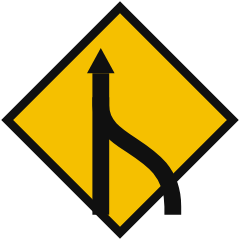
22. What does this sign warn a driver about?
Show answer
Answer A: Traffic from another roadway will enter the same lane ahead
Two traffic streams come together into one lane beyond this point, so drivers on both roadways have to adjust speed and spacing to fit together.
-
23. A driver extends the left arm out the window and bends it upward at the elbow. What does this signal mean?
Show answer
Answer B: A right turn
The left arm bent upward at the elbow is the standard hand signal for a right turn.
-
24. An entrance ramp joins a highway just before an exit ramp leaves it. What should you expect in that short section?
Show answer
Answer D: Vehicles crossing paths as some enter and others leave
In a weaving section entering traffic moves left while exiting traffic moves right over the same short stretch, so lane changes there need extra room and extra care.
-
25. A signal on an entrance ramp changes from red to green and lets one vehicle at a time onto the highway. What should you do?
Show answer
Answer A: Stop on the red and go on the green, one vehicle for each green
A ramp meter spaces vehicles out so they join the highway one at a time instead of arriving as a group, and it is a traffic signal like any other.
-
26. Why is passing another vehicle a bad idea in dense fog?
Show answer
Answer C: You cannot see far enough ahead to know the passing lane is clear
A pass needs a clear view of the road well beyond the vehicle you are overtaking, and fog takes exactly that away.
-
27. If an Oregon driver fails to file a required accident report, how long does the resulting DMV suspension of driving privileges continue?
Show answer
Answer B: Until the report is filed, or five years from the suspension date, whichever comes sooner
ORS 809.417 continues a suspension for failing to file a required accident report until the person files the report, or for five years from the date of suspension, whichever comes sooner.
-
28. You are waiting in a center two-way left-turn lane. What should you expect from oncoming traffic?
Show answer
Answer A: Oncoming drivers may enter the same lane to prepare their own left turns
Both directions share a two-way left-turn lane, so an oncoming vehicle may be waiting in it and you must never treat it as yours alone.
-
29. On a rural road, the driver of a slow farm tractor ahead of you signals a left turn even though there is no road or driveway in sight. What should you do?
Show answer
Answer B: Stay behind the tractor, because it may be turning into a field entrance
Farm equipment often turns into fields through gaps you cannot see, and it may swing wide to do so. Passing a vehicle that is signaling a left turn is a common cause of crashes.
-
30. A shared-use path crosses the road ahead at a marked crossing and people are already crossing on it. What should you do?
Show answer
Answer C: Yield and let them finish crossing the road
People already crossing at a marked crossing have the right of way, and a path crossing is a crossing of the roadway like any other.
-
31. If a driver causes or contributes to a crash while violating Oregon's driving-uninsured law, what suspension does DMV impose?
Show answer
Answer C: A one-year suspension, not lifted until future responsibility filing requirements are met
ORS 809.417 requires DMV to suspend the driving privileges of a person who was driving uninsured at the time of a crash for one year, and DMV will not reinstate privileges until future responsibility filing requirements are satisfied.
-
32. At an intersection where every approach carries this sign, two drivers arrive at exactly the same instant. Which of them goes first?

Show answer
Answer C: The driver on the right
Order of arrival decides who goes first, and when two vehicles arrive together the driver on the right proceeds while the other gives way.
-
33. You have just had bad news and you feel very upset. What should you do?
Show answer
Answer B: Wait until you have calmed down, or else let somebody else drive
Strong emotion takes attention away from the road as surely as alcohol or fatigue, so it is a reason not to drive yet.
-
34. A tractor-trailer is backing slowly across the roadway to enter a loading dock. What should you do?
Show answer
Answer C: Stop and wait until the truck has finished the maneuver
A backing truck driver has a very limited view and the trailer can swing unexpectedly. Trying to squeeze past in either direction risks being crushed.
-
35. On dry pavement in good weather, what is the smallest following gap you should keep?
Show answer
Answer A: About three seconds behind the vehicle ahead
Three seconds is the accepted minimum on dry roads in good visibility, and the gap should be longer in poor conditions.