
Oregon DMV Motorcycle Practice Test 44
- Questions25
- Correct to pass20
- Passing score80%
- Minimum age16 years
-
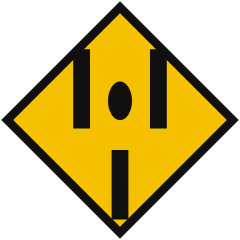
1. What must a driver be ready for beyond this sign?
Show answer
Answer C: Vehicles approaching from the opposite direction in the next lane over
The separation between the two directions runs out, so from that point oncoming vehicles share the same pavement and the driver has to keep right.
-
2. Someone has stepped into a marked crosswalk in the middle of a block ahead of you. What should you do?
Show answer
Answer A: Slow down, stop before the markings and let the person cross the street
A marked mid-block crosswalk carries the same duty as one at a corner: give way to the person crossing, stopping if that is what letting them cross safely takes.
-
3. Why should riders avoid the center strip of the lane, especially where traffic stops often?
Show answer
Answer A: Because it collects oil and grease dripped from other vehicles
Drippings from other vehicles build up in the center of the lane, and the buildup is heaviest at busy intersections and toll booths where traffic sits waiting.
-
4. Your light is green but the traffic beyond the intersection is stopped and there is no room on the far side. What should you do?
Show answer
Answer A: Wait behind the line until you can clear the far side
Entering an intersection you cannot clear blocks the cross traffic when their signal turns green, so you wait behind the line.
-
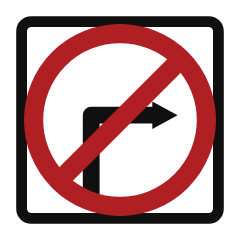
5. A driver's destination lies along the street to the right, and this sign stands at that corner. How should the driver reach it?
Show answer
Answer D: By going on and using a later intersection where turning is allowed
When a movement is barred at one corner the driver has to reroute, normally by continuing and coming back to the destination from a permitted approach.
-
6. Why may the mirrors and the headlight need readjusting when a passenger is carried?
Show answer
Answer D: Because the added weight changes the angle at which the motorcycle sits
Weight on the rear of the motorcycle raises the front, which aims the headlight and the mirrors higher than the rider intends.
-
7. What does the choke, or enrichener, do on a motorcycle that has one?
Show answer
Answer B: It gives the engine a richer fuel mixture so a cold engine will start
A cold engine needs more fuel in proportion to air, and the choke supplies that richer mixture until the engine warms up.
-
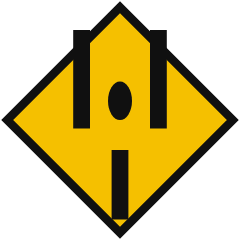
8. Beyond the point this sign refers to, which movement becomes unlawful?
Show answer
Answer D: Driving on the far side of the separation, against the flow
Once the two directions are separated, each roadway carries one-way traffic, so crossing to the other side means driving into oncoming vehicles.
-
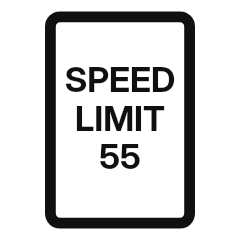
9. A driver passes this sign on an open road. Over what stretch does the figure it sets stay in force?
Show answer
Answer A: From the sign onward, in every lane, until another sign sets a different figure
The figure governs the road from the sign onward and binds every lane, and it stays in force until a later sign sets a different one.
-
10. A driver waiting to turn left appears to be looking straight at you. What should you assume?
Show answer
Answer C: That the driver may still not have seen you, and may turn across your path
Drivers look toward motorcycles without registering them, so eye contact is not evidence that the rider has been seen and no plan should depend on it.
-
11. How should a load be distributed between the two saddlebags?
Show answer
Answer B: Evenly, so the weight is balanced from side to side
An uneven load pulls the motorcycle toward the heavy side and makes it behave differently in left turns than in right turns.
-
12. When does Oregon require headlights to be turned on?
Show answer
Answer A: From sunset to sunrise, and any time you cannot see vehicles 1,000 feet ahead
Oregon requires headlights from sunset to sunrise and at any other time when conditions prevent you from seeing vehicles 1,000 feet ahead.
-
13. How do strong emotions affect driving?
Show answer
Answer B: They narrow your attention and make risky decisions more likely
Anger, worry and excitement all take attention away from the driving task and push drivers toward decisions they would not normally make.
-
14. You are waiting in a left-turn lane at a green light when a fire engine with lights and siren comes toward you in the oncoming lanes. What should you do?
Show answer
Answer D: Hold your position and let the fire engine pass
Turning across the path of an approaching emergency vehicle is exactly what you must not do; stay put until it has gone by.
-
15. At an intersection where every approach carries this sign, two drivers arrive at exactly the same instant. Which of them goes first?
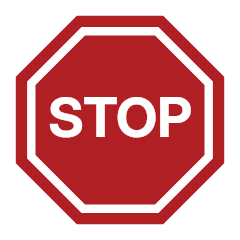
Show answer
Answer C: The driver on the right
Order of arrival decides who goes first, and when two vehicles arrive together the driver on the right proceeds while the other gives way.
-
16. You enter a corner faster than the turn can be taken. What is the most likely result?
Show answer
Answer A: The vehicle runs wide and may cross into another lane
Excess speed uses up the available grip, so the vehicle follows a wider arc than intended and drifts out of its lane.
-
17. May you exceed the posted speed limit in order to complete a pass?
Show answer
Answer C: No, the posted limit applies while you are passing too
The limit does not lift for passing; if you cannot complete the pass within it, there is not enough room and you should stay back.
-
18. As a center two-way left-turn lane reaches an intersection, the markings change into a single left-turn lane. What does that mean for you?
Show answer
Answer D: From that point it serves one direction only, so use it just to turn left
Where the shared lane becomes a marked turn bay it belongs to one direction of travel, and only vehicles making that left turn may occupy it.
-
19. Where should the least experienced riders be placed in a group?
Show answer
Answer C: Just behind the leader
Placing newer riders just behind the leader keeps the pace manageable for them and lets the more experienced riders behind keep an eye on them.
-
20. A sign on a freeway restricts trucks to the two right-hand lanes. What should a car driver expect in those lanes?
Show answer
Answer A: More heavy vehicles and slower changes of speed
A truck lane restriction concentrates heavy vehicles on the right, and those vehicles accelerate, brake and change lanes far more slowly than cars.
-
21. If an Oregon driver fails to file a required accident report, how long does the resulting DMV suspension of driving privileges continue?
Show answer
Answer B: Until the report is filed, or five years from the suspension date, whichever comes sooner
ORS 809.417 continues a suspension for failing to file a required accident report until the person files the report, or for five years from the date of suspension, whichever comes sooner.
-
22. Another vehicle is passing you on a two-lane road. What should you do with your speed?
Show answer
Answer A: Hold your speed or ease off slightly to shorten the pass
Speeding up strands the passing driver in the oncoming lane, while a steady speed or a slight lift lets the pass finish quickly and safely.
-
23. What does the T-CLOCS pre-ride inspection routine cover?
Show answer
Answer B: Tires and wheels, controls, lights, fluids, chassis and stands
T-CLOCS is a memory aid for a walk around check of tires and wheels, controls, lights and electrics, oil and other fluids, chassis, and side and center stands.
-
24. A driver slows to walking pace at this sign, never stops rolling and eases into the intersection. How is that treated?
Show answer
Answer B: It is a violation, because the vehicle never came to a complete halt
What is required is a full halt with the wheels no longer turning, so slowing down, however carefully, does not satisfy it.
-
25. You are leaving a private driveway and entering a public street. What are you required to do?
Show answer
Answer B: Stop and yield to traffic on the street and to pedestrians on the sidewalk
A driver entering a roadway from a driveway, alley or private road must stop and yield to traffic on the roadway and to pedestrians on the sidewalk being crossed.