
Oregon DMV Motorcycle Practice Test 40
- Questions25
- Correct to pass20
- Passing score80%
- Minimum age16 years
-
1. You have just had bad news and you feel very upset. What should you do?
Show answer
Answer B: Wait until you have calmed down, or else let somebody else drive
Strong emotion takes attention away from the road as surely as alcohol or fatigue, so it is a reason not to drive yet.
-
2. A driver on a hands free call looks straight at a red light and drives through it. What best explains this?
Show answer
Answer B: The eyes saw it but the brain did not process it
Attention, not eyesight, decides what a driver actually sees, and a loaded mind can leave a driver looking straight at a hazard without registering it.
-
3. A hands free phone conversation is which kind of distraction?
Show answer
Answer C: Cognitive, because your mind leaves the road
Hands free equipment removes the manual and visual parts of a call but not the mental load, and it is the mental load that makes a driver miss hazards.
-
4. Which clue best warns a rider that the door of a parked car is about to open?
Show answer
Answer B: Someone visible in the seat, or exhaust showing at the tailpipe
Occupied cars are the ones that open doors, so scan through rear windows and mirrors and look for exhaust or wheels turning as you approach.
-
5. In a normal signal cycle, what comes after a steady red indication?
Show answer
Answer A: A green indication that starts the next movement
Yellow is a warning that a movement is ending, so it never precedes a green; a red is followed by a green or a green arrow.
-
6. A large truck passes and hits you with a blast of wind. Which lane position leaves you the most room for error?
Show answer
Answer A: The center portion of the lane
A rider in the center portion of the lane has space on both sides to absorb the push of a wind blast without being shoved out of the lane.
-
7. You are ready to pull out of a parallel parking space into the traffic lane. What should you do?
Show answer
Answer C: Signal, check the mirror and blind spot, and wait for a gap
A driver leaving a parking space must yield to traffic already in the lane, so signal, look for the gap and only then move out.
-
8. You are driving on an open highway in a strong crosswind. What is the safest adjustment?
Show answer
Answer A: Reduce speed and keep a firm grip, expecting gusts on bridges and beside large vehicles
Gusts hit hardest in open gaps, on bridges and when passing high-sided vehicles, so a lower speed and a firm grip let you correct before you are pushed out of your lane.
-
9. What does a posted speed limit sign represent?
Show answer
Answer B: The maximum speed permitted under ideal conditions
A speed limit is an upper limit that assumes good weather, good visibility and light traffic, so the safe speed is often lower than the posted figure.
-
10. You are the second vehicle waiting to turn left on a green ball. Where should you wait?
Show answer
Answer A: Behind the stop line, until the first vehicle has actually turned
Only the lead vehicle should move into the intersection to wait; a second vehicle inside it is likely to be stranded there when the light changes.
-
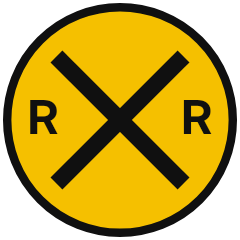
11. This sign leads to a crossing that has no gates and no flashing lights. What does that mean for the driver?
Show answer
Answer D: Nothing will warn of an approaching train, so the driver must check the tracks personally
At a passive crossing there is no active device to announce a train, so the whole judgment rests on the driver, who must approach slowly enough to stop after looking along the track.
-
12. Where is the oil and grease strip in a lane usually widest and most slippery?
Show answer
Answer D: At toll plazas, bus stops and intersections where vehicles sit and idle
Oil and coolant drip most where vehicles stop, idle and pull away, so the center strip is widest and slickest at toll booths, bus stops and busy intersections.
-
13. What is the purpose of carrying a first aid kit in your vehicle?
Show answer
Answer D: It lets you treat cuts and bleeding while the help is on its way
A kit is for simple first aid such as controlling bleeding until trained help arrives, not a substitute for calling for that help.
-
14. You are riding alongside a car in the next lane at the same speed. What is the problem?
Show answer
Answer B: You may be sitting in the driver's blind spot with nowhere to escape
A driver who cannot see the motorcycle may change lanes into it, so riders adjust speed to move ahead of or behind the vehicle instead of staying beside it.
-
15. During the tire check you find a nail driven into the rear tire. What should you do?
Show answer
Answer D: Have the tire repaired or replaced before the motorcycle is ridden
A punctured motorcycle tire can lose air suddenly, and a motorcycle has no second tire on that end to hold the machine up.
-
16. Why is it useful to watch the vehicle two or three places ahead of you?
Show answer
Answer C: You get an earlier warning of slowing traffic than brake lights give
Trouble travels back through a line of traffic, so seeing it start several vehicles ahead gives you a head start on braking.
-
17. The vehicle ahead of you has pulled out to pass a truck. May you follow it out and pass as well?
Show answer
Answer B: No, wait until it is done and judge the road for yourself
You cannot see past the vehicle ahead of you, and if it has to abort the pass there is nowhere for either of you to go.
-
18. What does a blood alcohol concentration of 0.08 mean for the driver of a car?
Show answer
Answer B: It is the level almost every state treats as legally intoxicated
In almost every state a driver at 0.08 or above is legally intoxicated whatever the driver seems like, but impairment starts well before that level is reached.
-
19. Before making a U-turn on a narrow street, what should the rider do first?
Show answer
Answer A: Check that the street is wide enough and clear in both directions
A U-turn commits the rider to crossing both directions of traffic in a space the machine may not fit into, so both the width and the traffic are judged before starting.
-
20. You have a green light at a school crossing, but the crossing guard steps out and holds up a stop sign toward you. What must you do?
Show answer
Answer A: Stop, because the crossing guard controls this crossing and outranks the signal
Directions from a crossing guard or a police officer take priority over signals and signs.
-
21. A friend asks for a ride and has no gear at all. What is the correct approach?
Show answer
Answer A: Provide a certified helmet, eye protection and covering clothing
A passenger hits the ground the same way the rider does, so a passenger needs the same protection: a certified helmet, eye protection, gloves, boots and covering clothing.
-
22. According to national crash research, how effective are helmets at preventing fatal injuries to motorcycle riders?
Show answer
Answer C: About 37 percent effective
Federal estimates put helmet effectiveness at roughly 37 percent for riders and about 41 percent for passengers in preventing fatal injuries.
-
23. How does a wet road change the distance you need to stop?
Show answer
Answer C: It lengthens it, so you need a much bigger gap ahead
Water between the tire and the road cuts grip, so braking distance grows and the gap that works on dry pavement is no longer enough.
-
24. A yellow diamond showing a truck is posted beside a quarry entrance. What is it warning about?
Show answer
Answer A: Trucks turning onto the highway from that entrance
A truck crossing or trucks entering sign is used where heavy vehicles pull onto the road from a site, and they accelerate slowly once they are on it.
-
25. A pedestrian is crossing at a corner where no crosswalk is painted on the pavement. What is your duty?
Show answer
Answer A: Yield, because a legal crosswalk exists at the corner even without paint
Every intersection has a crosswalk whether or not it is marked, and drivers must yield to pedestrians crossing there.