
Oregon DMV Motorcycle Practice Test 18
- Questions25
- Correct to pass20
- Passing score80%
- Minimum age16 years
-
1. You are about to drive a rental car that you have never driven before. What should you do?
Show answer
Answer A: Adjust the seat and the mirrors and find the controls before moving off
Hunting for the wipers or the lights in traffic is a distraction, so learn the layout while the vehicle is stopped.
-
2. How is the rear brake applied on a standard motorcycle?
Show answer
Answer D: By pressing down a pedal with the right foot
The rear brake pedal is in front of the right footrest and should be pressed down smoothly rather than stamped on.
-
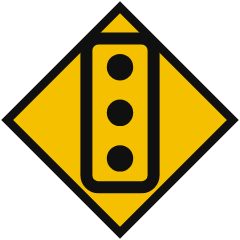
3. What does this sign require of the driver?
Show answer
Answer D: Reducing speed and being ready to stop at the intersection ahead
The advance notice asks the driver to slow and be ready to stop, while whether a stop is actually needed depends on the indication displayed on arrival.
-
4. An upward-pointing pentagon with a yellow legend and border on a blue background is used as
Show answer
Answer D: a county route marker
The pentagon serves both the school warning series and county route markers, and the blue background with yellow legend identifies the county route version.
-
5. You are approaching a refuse collection truck working along your street. What should you expect?
Show answer
Answer D: Workers stepping into the road around the truck
Collection crews move constantly between the truck and the curb, often from where you cannot see them, so slow right down and pass only when the whole area is clear.
-
6. Visibility drops suddenly and you decide to leave the highway. What is the safest way to do it?
Show answer
Answer A: Take the next exit or a wide pull off, well clear of the traffic lanes
Get right off the traveled way, and off the shoulder too if you can, because vehicles in poor visibility often drift onto the shoulder.
-
7. Driving at night you notice that the raised markers along the line beside you are throwing back red light. What does that tell you?
Show answer
Answer C: You are facing traffic and must get off that roadway
Red retroreflection is shown only toward traffic that should not be there, so a red return means the vehicle is heading the wrong way.
-
8. A pedestrian starts to cross against a Do Not Walk signal, right in front of you. What should you do?
Show answer
Answer D: Slow or stop and let the person reach safety
Even when a pedestrian is crossing unlawfully, a driver must take reasonable care to avoid hitting that person.
-
9. The driver ahead of you is straddling the lane line and is not signaling. How should you respond?
Show answer
Answer B: Stay back until you can see which lane that driver will take
A vehicle astride the line could move either way, so the only safe place is behind it where both possibilities are still covered.
-
10. Why is repeatedly changing lanes to work through heavy traffic a poor idea?
Show answer
Answer A: It raises the crash risk and saves almost no time
Each lane change adds a conflict with another vehicle, and in congestion the lanes move at similar average speeds, so the gain is negligible.
-
11. A yellow diamond in which one line joins another at an angle warns that
Show answer
Answer B: traffic from another roadway will merge into the driver's lane ahead
The merge sign warns that another traffic stream will join the same lane ahead, so drivers on both roadways must adjust speed and spacing.
-
12. On a narrow two-lane road a line of vehicles has built up behind you. What is the safe and courteous action?
Show answer
Answer D: Pull into a turnout or a safe wide spot and let them go by
A slow vehicle holding up a queue invites risky passing; using a turnout clears the road without anyone having to take a chance.
-
13. An orange sign reads RIGHT LANE CLOSED AHEAD. What is the correct response?
Show answer
Answer A: Move left in good time and keep a steady pace
The sign is placed well before the taper so that drivers can merge smoothly rather than braking hard where the lane actually closes.
-
14. The sign over the leftmost lane reads LEFT LANE MUST TURN LEFT. You are in that lane and want to go straight. What should you do?
Show answer
Answer C: Move out of the lane before the intersection if it is safe
A mandatory movement lane control sign makes the turn compulsory for that lane, so a driver who wants another movement must change lanes in advance.
-
15. Besides air pressure, what should a rider look for when inspecting the tires?
Show answer
Answer B: Tread depth, cuts, embedded objects and uneven wear
Worn or damaged tires lose grip and can fail suddenly, and uneven wear also warns of a pressure or alignment problem.
-
16. An emergency vehicle is stopped on the shoulder ahead with its lights flashing. What does the move over principle require?
Show answer
Answer D: Change lanes away from it, or slow down if you cannot
Move over laws ask you to give responders an empty lane, and where traffic or a two-lane road makes that impossible, you slow down instead.
-
17. What do the numbers on a pedestrian countdown display show?
Show answer
Answer A: The seconds remaining to finish a crossing already under way
The countdown runs during the pedestrian change interval and shows how many seconds are left before the crossing time ends.
-
18. During a pre-ride check, what should the throttle do when it is released?
Show answer
Answer A: Snap back to the closed position on its own
A throttle that does not close by itself can leave the engine running fast when the rider expects it to slow, so a sticking cable must be repaired before riding.
-
19. Why is a wet road at night harder to read than the same road in daylight?
Show answer
Answer A: The wet surface reflects light away and swallows the lane markings
A film of water sends your headlight beam onward instead of back to you, so lines, edges and people in dark clothing almost disappear.
-
20. In a tight, slow speed turn such as a parking lot U-turn, the rider should:
Show answer
Answer C: Lean the motorcycle while keeping the body upright
Keeping the body upright while the motorcycle leans lets the machine turn tightly and helps the rider hold balance at very low speed.
-
21. May you park across the entrance to a fire station?
Show answer
Answer D: No, an emergency exit must never be blocked
Emergency vehicles must be able to leave the moment a call comes in, so their entrances and exits are kept clear at all hours.
-
22. What is the first thing to do once your disabled vehicle is stopped on the shoulder?
Show answer
Answer A: Switch on the hazard warning lights so other drivers can see the vehicle
Hazard lights are the fastest way to make a stopped vehicle visible, and everything else can follow once traffic has been warned.
-
23. The street you are turning right onto has a bike lane along its right edge. Where should your vehicle end up?
Show answer
Answer B: In the first traffic lane to the left of the bike lane
A bike lane is not a travel lane for motor vehicles, so the nearest lane you may finish a right turn in is the first general traffic lane beside it.
-
24. You are already leaned over in a curve when you see loose gravel spread across the road ahead. What is the best response?
Show answer
Answer B: Slow gently, bring the bike more upright, and cross the gravel with steady throttle
A leaned tire has little grip left for braking or for loose stones. Reduce speed smoothly, get the motorcycle as upright as the curve allows, and hold a steady throttle across the gravel.
-
25. Two roads come together at a shallow angle under a MERGE sign, with no yield line on either one. What is expected of you?
Show answer
Answer D: Adjust your speed and position so you blend smoothly into the other traffic
A merge means neither road ends at a stop; drivers adjust speed and position so that the two streams fit together without stopping.