
Oregon DMV Motorcycle Practice Test 14
- Questions25
- Correct to pass20
- Passing score80%
- Minimum age16 years
-
1. You are about to pass a large truck on a two-lane highway. Which practice is correct?
Show answer
Answer A: Finish the pass without delay and expect wind turbulence beside the truck
Lingering beside a truck keeps you in its blind spot and exposes you to air turbulence. Pass on the left, keep moving, and move back only when you can see the whole truck in your mirror.
-
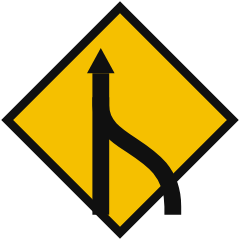
2. Why does the situation ahead of this sign deserve extra care from a motorcyclist?
Show answer
Answer C: Because a narrow machine is easy to overlook in a mirror or a blind spot
A motorcycle fills very little of a mirror and disappears easily into a blind spot, so the rider should adjust speed and lane position to stay visible where the streams come together.
-
3. Some states allow a left turn against a red light. Which movement is it?
Show answer
Answer A: A left turn from a one-way street onto another one-way street
The movement generally allowed on red is one-way to one-way, because the turn does not cross any lane of oncoming traffic; a few states also extend it to a two-way street turning onto a one-way street.
-
4. A bicyclist is riding around a single-lane roundabout in the middle of the lane as you wait to enter. What is your duty?
Show answer
Answer C: Yield to the bicyclist just as you would to a car
A bicyclist using the roundabout is traffic like any other vehicle and has the same claim to the circulating lane.
-
5. A reduced speed limit posted with this sign and a plaque giving hours is in force

Show answer
Answer C: during the hours shown on the plaque, or while the beacon is flashing
A school speed limit applies during the periods stated on the plaque or while the attached beacon flashes, and the regular limit governs outside those periods.
-
6. A delivery truck is parked in your lane and you must use the oncoming lane to get around it. Who has the right of way?
Show answer
Answer D: The oncoming traffic, because their lane is clear
The driver whose own lane is obstructed waits, because using the other lane is a favor from oncoming traffic, not a right.
-
7. You are behind a snow plow working on a highway. What is the correct way to drive?
Show answer
Answer C: Stay well back and do not try to pass it
A plow throws snow, runs wider than its body and works on the poor surface ahead of it, so the cleared road behind it is the safest place to be.
-
8. A sign reads MINIMUM SPEED 40. What does it require of a driver?
Show answer
Answer C: Not to drive below that speed when conditions allow
A minimum speed limit keeps unnecessarily slow vehicles from obstructing traffic, but it never overrides the duty to slow down for weather or congestion.
-
9. A deer crosses the road ahead of you and disappears into the trees. What should you expect?
Show answer
Answer A: More animals may follow, since deer usually move in groups
Deer commonly travel in groups, so one animal crossing is a warning that others are close by. Slow down and stay ready to stop well past the point where it crossed.
-
10. You have turned right into the nearest lane but you need the left lane soon. When should you move over?
Show answer
Answer A: After the turn is finished, once you have checked mirrors and blind spot
Complete the turn in the proper lane first, then make a normal lane change with mirror and blind spot checks once you are established on the new street.
-
11. You realize you have just gone past your exit on a freeway. What should you do?
Show answer
Answer C: Carry on to the next exit and turn around there
A missed exit costs a few minutes, while backing up or cutting across the striped gore area puts you in the path of traffic that is not expecting it.
-
12. Which feature suggests that a helmet is an uncertified novelty helmet?
Show answer
Answer D: A shell less than one inch thick with no firm foam liner
Novelty helmets are typically thin and very light because they lack the stiff energy absorbing liner that a certified helmet uses to manage an impact.
-
13. Some toll facilities use signs and markings with a purple background or a purple stripe. What do they identify?
Show answer
Answer D: Lanes reserved for vehicles with an electronic toll account
Purple is assigned to lanes and ramps restricted to vehicles with a registered electronic toll collection account, so drivers without one must stay out.
-
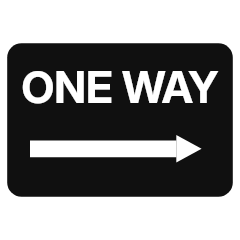
14. A driver on the street this sign governs is preparing to turn left at the next corner. Which lane should the vehicle be in beforehand?
Show answer
Answer A: The lane closest to the left curb
All the traffic here runs the same way, so nothing is coming toward the driver and the turn is taken from the extreme left lane rather than from beside the middle of the roadway.
-
15. The light ahead is green, but traffic beyond the intersection is backed up so far that you could not clear it. What is the correct action?
Show answer
Answer D: Wait behind the stop line until there is room on the far side
Entering an intersection you cannot clear blocks cross traffic and pedestrians, so you should hold your position until space opens on the other side.
-
16. What triggers Oregon's Flashing School Speed Limit Sign to require the reduced 20 mph limit, regardless of the time of day?
Show answer
Answer D: The yellow light on the sign actively flashing
The Oregon Driver Manual explains that any time the yellow light on a Flashing School Speed Limit Sign is flashing, it indicates children are arriving at or leaving school and the 20 mph limit applies.
-
17. A large truck is passing you on a two-lane road. What is the safest thing to do?
Show answer
Answer C: Keep right in your lane and ease off the gas a little
Staying in your own lane and easing off shortens the pass without forcing you onto a soft shoulder or into the truck's path.
-
18. A yellow sign reading DEAD END is posted at the entrance to a street. What does it mean?
Show answer
Answer D: The street ends and there is no way through
A dead end street stops at its far end, so a driver who enters must come back out the same way.
-
19. According to the Oregon Driver Manual, when may a driver turn in front of a streetcar or light rail train traveling in the same direction from an adjacent lane?
Show answer
Answer A: Never, even if the streetcar or train is currently stopped
The Oregon Driver Manual instructs drivers to never turn in front of a streetcar or light rail train traveling in the same direction from an adjacent lane, even if the streetcar or train is currently stopped.
-
20. In the code that governs pavement markings, what does a double line stand for?
Show answer
Answer B: A maximum restriction
The marking code is consistent: a double line means the strongest restriction, a solid line discourages or forbids crossing, and a broken line is permissive.
-
21. What does the RESERVE position on a fuel supply valve do?
Show answer
Answer C: It draws on the small amount of fuel left at the bottom of the tank
A fuel supply valve normally offers OFF, ON, RESERVE and PRIME, and RESERVE taps the last of the fuel so the rider can reach a station.
-
22. How should riders in a staggered formation pass another vehicle?
Show answer
Answer D: One rider at a time
Passing one rider at a time keeps each pass short and prevents the group from occupying the other lane longer than necessary.
-
23. What does the last step of T-CLOCS, Stands, ask a rider to check?
Show answer
Answer D: That the stands are not bent and that their springs hold them up
A bent stand or a weak spring can let the stand fall while riding, so both the sidestand and the centerstand are checked for damage and spring tension.
-
24. A driver disregards this sign and turns so as to travel against the direction it establishes. What is the immediate danger?
Show answer
Answer D: The driver will face traffic head on, because every lane comes the other way
Turning against the established direction puts the vehicle nose to nose with all the traffic on that street, which is why the mistake has to be corrected at once.
-
25. What Oregon maximum speed applies in a business district or a school speed zone?
Show answer
Answer B: 20 mph
Oregon sets 20 mph in business districts and school speed zones, while residential districts, public parks and permitted ocean shores are 25 mph.