
Oregon DMV Permit Practice Test 20
- Questions35
- Correct to pass28
- Passing score80%
- Minimum age15 years
-
1. How should you position your vehicle for a right turn from a two-way street?
Show answer
Answer B: As close as practical to the right curb or edge, then turn into the nearest right lane
Right turns are made from the lane nearest the right edge into the nearest available lane, which keeps the turn tight and prevents a wide sweep into other traffic.
-
2. Your left-turn lane shows a flashing yellow arrow. What does that indication allow?
Show answer
Answer B: A left turn after yielding to oncoming traffic and to pedestrians
A flashing yellow arrow marks a permissive left turn: the movement is allowed, but oncoming vehicles and pedestrians keep the right-of-way.
-
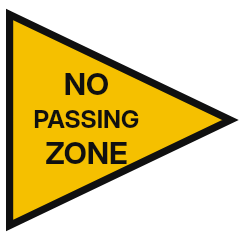
3. Where does the restriction that starts at this sign come to an end?
Show answer
Answer D: Where the centerline markings show that overtaking is allowed again
The sign marks the start of the restricted section, and the centerline markings along the road show how far it runs and where overtaking becomes lawful again.
-
4. You are following closely behind a vehicle you intend to pass on a two-lane road. What should you do first?
Show answer
Answer D: Drop back to give yourself room to build speed before you pull out
From close behind you cannot see far enough ahead and you have no room to gather speed, so the pass takes longer and starts blind.
-
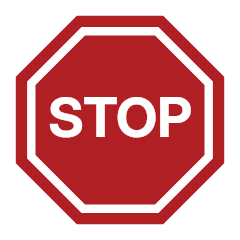
5. A driver slows to walking pace at this sign, never stops rolling and eases into the intersection. How is that treated?
Show answer
Answer B: It is a violation, because the vehicle never came to a complete halt
What is required is a full halt with the wheels no longer turning, so slowing down, however carefully, does not satisfy it.
-
6. In slow summer traffic the temperature gauge climbs into the red. What should you do first?
Show answer
Answer A: Turn off the air conditioner and turn on the heater to draw heat from the engine
The heater core acts as an extra radiator, and shutting off the air conditioner reduces engine load. If the gauge keeps climbing, pull over and shut off the engine, and never open a hot radiator cap.
-
7. A school crossing guard steps into the roadway and holds up a stop paddle. What must you do?
Show answer
Answer D: Stop and stay stopped until the guard and the children have left the road
A crossing guard directs traffic with legal authority; you must remain stopped until both the guard and the children are clear of the roadway.
-
8. A yellow sign reads SOFT SHOULDER. What is it telling you?
Show answer
Answer C: The shoulder may not carry the weight of a vehicle
A soft shoulder is unpaved and can let a wheel sink, so a driver who leaves the pavement there may lose control or become stuck.
-
9. The crossing gates begin to lower while your vehicle is still on the railroad tracks. What should you do?
Show answer
Answer B: Keep going forward and push through the gate if it should block your way
Gates are made to break away, and driving forward off the tracks is far safer than staying between them or backing up.
-
10. Under Oregon law, how closely may a driver follow an emergency vehicle or ambulance that is responding to a fire alarm or emergency?
Show answer
Answer C: No closer than 500 feet
ORS 811.150 makes it an offense to follow an emergency vehicle or ambulance responding to a fire alarm or emergency at a distance closer than 500 feet.
-
11. A highway lane is marked with a large white diamond and signed as a high-occupancy vehicle lane. Who may use it?
Show answer
Answer B: Only vehicles carrying at least the number of occupants shown on the sign, during the posted hours
The diamond marking identifies a preferential lane whose occupancy requirement and hours of operation are stated on the accompanying signs.
-
12. A regulatory sign reads TURN ON HEADLIGHTS NEXT 15 MILES. What does it require?
Show answer
Answer C: Low beam headlights on for that stretch, day or night
Such a section is signed where a road is hard to see along, and the requirement is to run headlights, not just daytime running lamps, through the whole stretch even in bright daylight.
-
13. You are towing a trailer and turning right at an intersection. What must you allow for?
Show answer
Answer D: The trailer cuts the corner, so swing wider than usual
A trailer follows a shorter path than the towing vehicle, so its wheels track inside your line and can mount the curb unless you take the turn wide.
-
14. Your vehicle has a blind spot warning light in the door mirror. What should that mean for your habits?
Show answer
Answer B: You still check the blind spot yourself, because the system can miss a rider
Blind spot systems are an aid, not a substitute, and a motorcycle or a bicycle can be missed or arrive faster than the sensor expects.
-
15. You get into a heated argument with a passenger while driving. What should you do?
Show answer
Answer D: End the discussion or pull over to finish it
Anger narrows attention and encourages risk, and a conversation you cannot let go of is a passenger you should be parked to talk with.
-
16. About how far ahead do low beam headlights let you see on a dark road?
Show answer
Answer B: About 250 feet
Low beams light roughly 250 feet of road, and high beams roughly 350 to 500 feet, which sets the limit on a safe night speed.
-
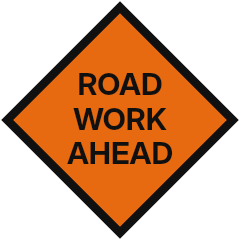
17. How should speed and following distance be adjusted beyond this sign?
Show answer
Answer D: Cut speed and leave a longer gap, because traffic can stop without warning
Traffic in these areas stops and starts unexpectedly and there is little room to steer around a problem, so extra space is what prevents a rear-end collision.
-
18. You approach a one-lane bridge and there is a yield sign facing your side of it. What does that mean?
Show answer
Answer B: Oncoming traffic crosses the bridge first and you wait at the approach
At a one-lane bridge the yield sign tells one direction to give way, so you wait clear of the bridge until oncoming traffic has crossed.
-
19. A train has just passed a crossing that carries more than one set of tracks. What should you do?
Show answer
Answer B: Wait until the warning devices stop and you can see clearly along every track
A passing train can hide a second one coming on another track, so wait for the signals to clear and check each track before moving.
-
20. When should most of your braking for a turn be finished?
Show answer
Answer B: Before you begin to turn the wheel
Slow to the right speed before the turn begins; braking hard while turning uses up the grip the tires need for steering.
-
21. A child in the back seat unfastens a seat belt while you are on the freeway. What should you do?
Show answer
Answer A: Pull off safely and refasten the belt
Turning or reaching back takes your eyes and hands off a high speed task, so leave the freeway or use the shoulder only if there is no exit, then fix the belt.
-
22. A school crossing guard has returned to the curb but two children are still walking across the road. When may you go?
Show answer
Answer C: Only after the children have reached the far sidewalk
The guard leaving the road does not end your duty; you stay stopped until every child is clear of the roadway.
-
23. You have a steady green ball to turn left, and the oncoming traffic gets a green left arrow. What does that mean for you?
Show answer
Answer C: Oncoming vehicles will turn across your path, so you must wait
A green ball is permissive, so when the oncoming side receives a protected arrow those vehicles have priority and you must yield until they clear.
-
24. At 45 mph you look at a navigation screen for four seconds. Roughly how far do you travel unseeing?
Show answer
Answer D: About 260 feet
At 45 mph you cover roughly 66 feet a second, so four seconds on a screen is around 260 feet of road that you never looked at.
-
25. In Oregon, what maximum speed applies on a road or highway with no other designation?
Show answer
Answer C: 55 mph
Oregon sets 55 mph as the maximum for roads and highways that carry no other designated speed, while designated interstate segments can be posted higher.
-
26. You see an open curb space on the opposite side of a two-way street. What should you do?
Show answer
Answer B: Drive on, turn around, and come back on that side
You must park on the right, facing the direction of travel, so reaching a space on the other side means going around rather than crossing into it.
-
27. A driver has to stop for a train at this sign. How far back from the nearest rail should the vehicle be held?

Show answer
Answer C: No closer than roughly fifteen feet
A train and its load overhang the rails, so stopping no closer than about fifteen feet keeps the vehicle outside the space the train actually sweeps.
-
28. Why is passing on a curve prohibited even when the traffic seems light?
Show answer
Answer C: You cannot see far enough around it to know the lane is clear
A pass is only as safe as the distance you can see, and a curve hides the very lane the maneuver uses.
-
29. In most states, how far before a turn must your signal already be on in city traffic?
Show answer
Answer B: At least 100 feet, roughly the length of six or seven cars
Most states require the signal for at least 100 feet before a turn in city driving, which gives drivers behind you time to react before you slow; several require more at higher speeds.
-
30. How much more energy must your brakes absorb if you double your speed?
Show answer
Answer D: About four times as much, since energy rises with the square of speed
Kinetic energy grows with the square of speed, so twice the speed means about four times the energy and a far longer braking distance.
-
31. A fire truck with lights and siren has just passed you and is heading down the same road. How closely may you follow it?
Show answer
Answer B: Well back, because following a responding emergency vehicle closely is illegal
Following a responding emergency vehicle closely is prohibited; the exact minimum distance is set by each state, so stay far enough back to keep the scene and other responders clear.
-
32. You must cross a stretch of water lying across the road that you know is shallow. What is the right technique?
Show answer
Answer A: Slow down before you reach it and cross steadily in a low gear
Slow before the water, then keep a steady low speed so you do not throw water over the engine or lose steering. Test the brakes gently once you are through.
-
33. On an Oregon highway posted at 65 mph or greater, exceeding the limit by more than 10 but not more than 20 mph is punishable as which class of violation?
Show answer
Answer C: Class B traffic violation
ORS 811.109 sets a different tiering for highways posted at 65 mph or above: up to 10 mph over is Class C, 11 to 20 mph over is Class B, and more than 20 mph over is Class A.
-
34. Where is a three-point turn most clearly a bad idea?
Show answer
Answer A: On a busy street near a curve, where approaching drivers cannot see you
The maneuver leaves you blocking the road for several seconds, so it needs light traffic and a long clear view; a blind curve gives neither.
-
35. Where is passing prohibited even when no line is visible?
Show answer
Answer D: On a curve or near the crest of a hill, at intersections and at railroad crossings
Passing is prohibited wherever your view of oncoming traffic is blocked or where vehicles may cross your path, which includes hills, curves, intersections and rail crossings.