
Oregon DMV Permit Practice Test 15
- Questions35
- Correct to pass28
- Passing score80%
- Minimum age15 years
-
1. As a general rule, how far should you travel along a center two-way left-turn lane before you turn?
Show answer
Answer C: Only a short distance, just enough to slow down and wait for a gap
The center lane is for making or preparing a left turn, so you enter it only shortly before the turn and never travel along it as a through lane; several states set a specific limit such as 200 or 300 feet.
-
2. A center lane is bordered by a solid yellow line on the outside and a broken yellow line on the inside, with left-turn arrows painted in it. How may you use that lane?
Show answer
Answer A: Only to make a left turn or to prepare for one from either direction
That marking identifies a two-way left turn lane, which may only be used for left turns or to prepare for a left turn and never for travel or passing.
-
3. Why is being predictable an important part of driving safely?
Show answer
Answer A: Because other road users are able to plan around what you are doing
Other drivers make their decisions from what they expect you to do, so surprises are what produce collisions.
-
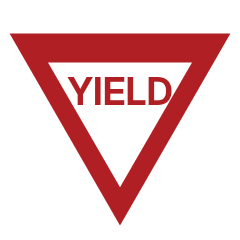
4. Apart from other vehicles, who else must a driver let go first at this sign?
Show answer
Answer A: Pedestrians and cyclists already in or entering the crossing
The duty to give way covers every road user who has the right of way at that point, including people walking or cycling across the driver's path.
-
5. You notice a bulge on the sidewall of one of your tires. What should you do?
Show answer
Answer D: Have the tire replaced before driving far, because it could blow out
A sidewall bulge means the internal cords have broken and only the rubber is holding the air. The tire can fail suddenly at any speed.
-
6. A large electronic advertising sign beside the road catches your eye. What should you do?
Show answer
Answer A: Glance briefly and return your eyes to the road
Bright changing displays are designed to hold attention, so treat them like any roadside object and give them no more than a brief glance.
-
7. A traffic signal ahead is showing a flashing red light. What does it require?
Show answer
Answer C: Stop completely, then go when the way is clear, as at a stop sign
A flashing red light has the same meaning as a stop sign: stop completely, yield to traffic and pedestrians, then proceed when it is safe.
-
8. How does eating a large meal before drinking affect impairment?
Show answer
Answer D: It slows absorption but the alcohol still reaches the blood and impairs you
Food delays how quickly alcohol enters the bloodstream, which can make the peak arrive later, but all of the alcohol is eventually absorbed.
-
9. The sun is low behind you and shining into the eyes of oncoming drivers. What should you do?
Show answer
Answer C: Turn on your headlights and expect oncoming drivers not to see you
Drivers facing the low sun may not see you at all, so make yourself as visible as possible and give way rather than insisting on your right of way.
-
10. According to the Oregon Driver Manual, when may a driver turn in front of a streetcar or light rail train traveling in the same direction from an adjacent lane?
Show answer
Answer A: Never, even if the streetcar or train is currently stopped
The Oregon Driver Manual instructs drivers to never turn in front of a streetcar or light rail train traveling in the same direction from an adjacent lane, even if the streetcar or train is currently stopped.
-
11. Crossing a parking lot on a hot day, you see a young child alone in a locked car. What should you do?
Show answer
Answer A: Call 911 right away and stay with the vehicle
The inside of a parked car can reach lethal temperatures within minutes, so a child left alone in one is an emergency.
-
12. How much moving water is generally enough to float and carry away most passenger vehicles?
Show answer
Answer D: About one foot
About a foot of moving water will float most cars, and even less will stall an engine. That is why the rule is to turn around instead of judging the depth.
-
13. May you stop in a marked bicycle lane to let a passenger out?
Show answer
Answer B: No, stopping there forces riders into the traffic lane
A vehicle stopped in a bike lane pushes riders out into moving traffic, which is exactly what the lane exists to prevent.
-
14. You reach an intersection showing a steady red light, and a stop line is painted across your lane. Where must you bring the vehicle to a complete stop?
Show answer
Answer C: Before the stop line
A steady red requires a complete stop before the marked stop line. Where there is no stop line you stop before the crosswalk, and where there is neither, before entering the intersection.
-
15. An upward-pointing pentagon with a yellow legend and border on a blue background is used as
Show answer
Answer D: a county route marker
The pentagon serves both the school warning series and county route markers, and the blue background with yellow legend identifies the county route version.
-
16. The light ahead is green, but traffic beyond the intersection is backed up so far that you could not clear it. What is the correct action?
Show answer
Answer D: Wait behind the stop line until there is room on the far side
Entering an intersection you cannot clear blocks cross traffic and pedestrians, so you should hold your position until space opens on the other side.
-
17. Which combination best reduces the chance of hydroplaning?
Show answer
Answer D: Good tread depth, correct tire pressure and lower speed in the rain
Tread channels water away, correct pressure keeps the tire's shape, and lower speed gives the tire time to push water aside. Hydroplaning can begin at surprisingly modest speeds.
-
18. What is a marked loading zone for?
Show answer
Answer A: Loading and unloading only, not for general parking
A loading zone is reserved for actively loading or unloading goods or passengers; leaving a vehicle there for other reasons is a parking violation.
-
19. You are parked legally, but a police officer tells you to move the vehicle. What should you do?
Show answer
Answer B: Move it as directed, because an officer overrides the signs
Directions from a police officer or a firefighter take precedence over signs and markings, whether they are directing traffic or clearing a street.
-
20. A yellow diamond shows a car with wavy lines behind its rear tires. What is the warning?
Show answer
Answer D: The surface loses grip badly when it is wet
The slippery when wet sign marks a stretch where traction falls off sharply in rain, so speed and braking must be reduced well in advance.
-
21. You leave a brightly lit service area onto a dark rural road. Why should you slow down for a while?
Show answer
Answer C: Your eyes need time to adjust, so at first you see less
Eyes take a few minutes to adapt from bright light to darkness, and during that time you can see much less than your headlights actually show.
-
22. On a rural two-lane road you pass small blue signs, each naming one business with an arrow and a distance. What are they?
Show answer
Answer D: Tourist-oriented directional signs for traveler businesses
Tourist-oriented directional signs carry a white legend on blue and are used on rural conventional roads to guide travelers to eligible businesses.
-
23. You are on a one-way street with two marked lanes. May you pass a slower vehicle on the right?
Show answer
Answer A: Yes, using the right lane, provided that the move is safe and signaled
On a roadway with two or more marked lanes in your direction, moving into the free lane and going by is a normal lane change rather than an unlawful pass.
-
24. What is the safest way to leave a perpendicular parking space in a busy lot?
Show answer
Answer B: Back out slowly, checking both ways and yielding
Backing out gives you the poorest view of any maneuver, so it must be done slowly, with checks in both directions and with yielding to whoever is already there.
-
25. You are driving along a street lined with parked cars. What should you watch for?
Show answer
Answer B: Doors opening, vehicles pulling out and pedestrians stepping from between cars
Parked cars hide people and can move without warning. Keep as much space from them as you safely can and cover the brake.
-
26. Where is the safest place for children under 13 to ride?
Show answer
Answer C: In the back seat
The back seat keeps children away from the force of a deploying front air bag and is farther from the most common impact area, which is why it is recommended through at least age 12.
-
27. You have just passed a large truck on the freeway. Why is it dangerous to pull back in front of it and then brake for your exit?
Show answer
Answer B: A loaded truck needs much more distance to stop than a car
A fully loaded tractor-trailer can need the length of a football field or more to stop from highway speed. Cutting in and braking leaves the driver no room to avoid hitting you.
-
28. Heavy trucks have worn deep ruts into a highway lane and rain has filled them. What is the danger?
Show answer
Answer D: Water collects in them, so the tires can lose contact with the road
Ruts hold standing water long after the rest of the lane has drained, which makes them the most likely place to start hydroplaning.
-
29. When should you arrange your way home if you plan to drink?
Show answer
Answer C: Before the first drink
Judgment is the first thing alcohol weakens, so the plan has to be made while you can still make a good one.
-
30. You have stopped at a stop line but parked cars hide the cross street. What comes next?
Show answer
Answer C: Edge forward to where you can see, stopping again if needed
The legal stop at the line is only the first stop; you then move up slowly to a point where you can see, and stop again if traffic requires it.
-
31. You turn left onto a road that has a center two-way left-turn lane. In which lane should you be traveling once the turn is finished?
Show answer
Answer D: The first through lane to the right of the center turn lane
The shared center lane is only for turning movements, so even where a state lets you pause in it to merge you must end up in the first ordinary travel lane beside it.
-
32. A sign with a blue background and a white legend and border tells road users about
Show answer
Answer A: services such as fuel, food, lodging, hospitals and rest areas
Blue is the background of the general service series, which points travelers toward the services available along or near the route.
-
33. At an intersection the signal flashes red toward you and flashes yellow toward the cross street. Who must yield?
Show answer
Answer D: You must, because the flashing red faces your road
A flashing red means stop and yield like a stop sign, while a flashing yellow lets the other road proceed with caution.
-
34. When does Oregon require headlights to be turned on?
Show answer
Answer A: From sunset to sunrise, and any time you cannot see vehicles 1,000 feet ahead
Oregon requires headlights from sunset to sunrise and at any other time when conditions prevent you from seeing vehicles 1,000 feet ahead.
-
35. What is true about driving away from a crash you were involved in?
Show answer
Answer B: It is a serious offense, even if the other driver has driven away too
Leaving the scene is a criminal offense in every state, and the behavior of the other driver does not excuse it.